Property Transfer Procedure in Dubai: Steps, Fees and Guide (2026)
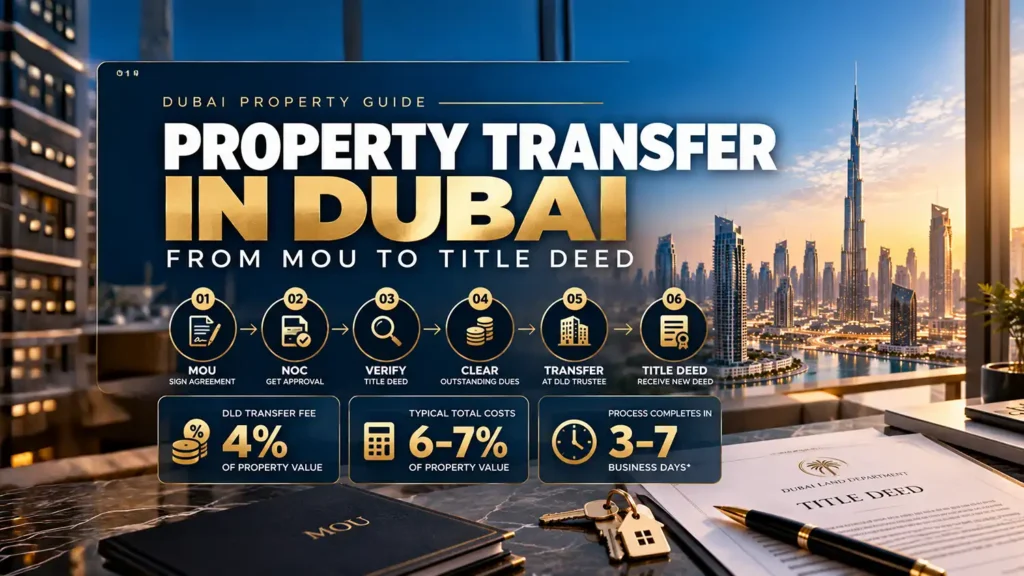
Every property transfer procedure in Dubai follows the same six steps, and the entire process wraps up in 3 to 7 business days once your documents are ready. That’s faster than most cities. However, speed alone doesn’t make it simple. One missing document, one unpaid service charge, one expired NOC, any of these can stall your transfer for weeks. Because of this, we’ve broken down every stage, every fee, and every paper you’ll need so nothing catches you off guard.
Whether you’re an Indian investor wiring funds from Mumbai or a resident upgrading from a studio to a villa, the process is the same at the Dubai Land Department (DLD). And at Divine Living, we walk every client through each stage personally, because paperwork shouldn’t be the reason a good investment falls apart.
Who Does What During a Property Transfer Procedure in Dubai?
In total, five parties are involved in every transfer. Understanding each role saves you from chasing the wrong person at the wrong time.
Party | Role in the Transfer |
|---|---|
Investor (the one acquiring the property) | Pays the investment amount and DLD fees, then receives the title deed |
Current owner | Obtains the NOC, clears all outstanding dues, and hands over the unit |
Developer | Confirms that all service charges are settled before issuing the NOC |
DLD trustee office | Processes the transfer on behalf of the DLD and collects government fees |
Dubai Land Department | Records the transaction, cancels the old deed, and issues a new title deed |
Notice that your real estate broker isn’t on this list. Although a RERA-authorised broker coordinates the process, the legal transfer happens between the five parties above. Your broker’s job is to make sure everyone shows up with the right documents at the right time.
Title Deed Meaning vs Oqood Meaning: Clear the Confusion First
Investors mix up these two terms constantly, and as a result, the confusion leads to real mistakes. So let’s settle it before going further.
What Does Title Deed Mean in Dubai?
The title deed meaning in Dubai is straightforward. It’s the official ownership document issued by the DLD for a completed, ready-to-occupy property. It carries the property owner’s full name, the plot number, the unit size, and the registered location. Consequently, when a transfer finishes, the DLD cancels the previous deed and prints a new one in the new owner’s name. You can verify any title deed directly through the DLD’s website or app.
For title deed verification Dubai residents should use the DLD’s REST app or visit a service centre. Simply enter the title deed number and the system confirms whether the deed is genuine, whether any loans are registered against it, and whether any court orders restrict the unit. Skip this step at your own risk.
What Does Oqood Mean?
The oqood meaning is just as simple, yet many investors never hear the word until they’re mid-transaction. Oqood Dubai registration is a temporary ownership record for off-plan properties, units that are still under construction. The DLD registers the agreement between the investor and the developer so that both sides are protected during the building phase. Furthermore, once the project is completed and handed over, the Oqood converts into a full title deed automatically.
FAQ: Can I resell a property that’s registered under Oqood?
Yes, but it isn’t as straightforward as reselling a ready property. In particular, the developer must approve the resale first, and most developers won’t give approval until the investor has paid a minimum percentage of the total investment usually 30% to 40%. In addition, some developers charge an administrative fee for processing the Oqood transfer. Therefore, always check your developer’s resale policy before committing to an off-plan opportunity.
Point | Title Deed | Oqood |
|---|---|---|
Property stage | Ready and completed | Under construction (off-plan) |
What it proves | Final, permanent ownership | Temporary ownership during construction |
How resale works | Transfer at a DLD trustee office | Requires developer approval first |
What happens at handover | Nothing, it’s the final document | Automatically becomes a title deed |
Documents You’ll Need Before the Transfer Begins
Above all, gathering documents early is the single best thing you can do to avoid delays. Here’s the full list, and who’s responsible for bringing each one.
Document | Who Brings It | Why It Matters |
|---|---|---|
Valid passport (and Emirates ID or visa copy for residents) | Both sides | Identity verification at the trustee office |
Original title deed | Current owner | Proves legal ownership of the unit |
Signed MOU or Form F | Both sides | States the agreed investment amount and terms |
No Objection Certificate (NOC) | Current owner obtains from the developer | Confirms all service charges and dues are cleared |
Mortgage clearance letter (if applicable) | Current owner obtains from the bank | Required only if a loan is registered against the property |
Manager’s cheques | Investor | Used to pay the investment amount and government fees |
Power of Attorney (if applicable) | Whoever can’t attend in person | Allows a trusted representative to sign on their behalf |
One detail that trips people up: the names on every document must match exactly. For instance, if your passport says “Mohammed” but the MOU says “Mohamed,” the DLD will reject the paperwork. As a result, you should check this before you reach the trustee office, not after.
The Property Transfer Procedure in Dubai: All Six Steps
Here’s the actual sequence for a resale of a completed, ready property. Off-plan transfers follow a slightly different path, which we cover in a separate section below.
Step 1 – Sign the Memorandum of Understanding (MOU)
Most resale transactions start with the MOU, often written on the DLD’s standard Form F. This document locks in the agreed investment amount, the payment schedule, the handover date, and any conditions both parties have agreed upon. The investor typically pays a 10% deposit at this stage.
Read every clause. Don’t skim. Instead, check the unit number, the names, and the payment breakdown. If something doesn’t match the verbal agreement, flag it now, not after you’ve signed. In short, a solid MOU protects both sides and sets the pace for everything that follows.
Step 2 – Obtain the No Objection Certificate (NOC)
After signing the MOU, the current owner requests an NOC from the developer. The developer checks that all service charges in Dubai real estate are settled and then issues the certificate. Typically, this takes 5 to 7 working days, and the fee ranges from AED 500 to AED 5,000 depending on the developer.
Here’s a tip that saves time: apply for the NOC the same day the MOU is signed. Most delays happen because the current owner waits a week or two before starting the application. Moreover, since the transfer can’t move to the next step without the NOC, every day of delay pushes the entire timeline forward.
Step 3 – Verify the Title Deed
This is the title deed verification Dubai professionals always insist on, and for good reason. Before paying any large amount, confirm with the DLD that the current owner is the legitimate property owner. Similarly, check that no mortgage, court case, or travel ban is registered against the property.
You can do this through the DLD’s REST app, at any DLD service centre, or through a RERA-authorised broker. Don’t take the current owner’s word for it. After all, verification takes minutes and can save you from fraud that takes years to resolve.
FAQ: How do I verify a title deed in Dubai?
Download the DLD’s REST app, enter the title deed number, and the system will confirm ownership, any registered mortgages, and any legal restrictions. You can also visit a DLD service centre in person. Verification is free through the app and takes under two minutes. Always complete this step before signing the final paperwork or transferring any funds.
Step 4 – Clear Any Existing Mortgage
If the current owner has a bank loan registered against the property, that loan must be settled or transferred before the DLD will approve the transfer. The current owner requests a settlement letter from the bank, pays off the remaining balance, and obtains a liability clearance letter.
Banks can take 2 to 4 weeks to process this, which is why it needs to start early. Alternatively, in some situations, the investor can assume the existing loan; but only if the bank agrees and the investor qualifies. For a deeper look at how financing works, see our Dubai mortgage guide for foreign investors.
Step 5 – Attend the Trustee Office Appointment
Both parties book a slot at an authorised DLD trustee office. On the day, the investor brings manager’s cheques for the full investment amount, the 4% DLD transfer fee, and the trustee office fee. In other words, personal cheques and cash aren’t accepted, only manager’s cheques or bank drafts.
The trustee office staff review every document, verify identities, and process the transfer through the DLD system. If one party can’t attend, a representative with a valid Power of Attorney can sign on their behalf. Overall, the entire appointment takes roughly an hour, sometimes less if the paperwork is clean.
Step 6 – Receive the New Title Deed
Once the trustee office processes the transfer, the DLD cancels the old title deed and issues a new one in the investor’s name. This typically happens the same day. Afterwards, transfer the DEWA (electricity and water) account to your name, update the building management records, and if you plan to lease the property, register the Ejari tenancy contract.
What Are the Conveyancing Fees Dubai Investors Should Expect?
Dubai doesn’t have a formal conveyancing system like the UK. There’s no separate solicitor step, no stamp duty, no land registry fee on top of the transfer fee. Nonetheless, the total conveyancing fees Dubai investors will pay add up, and it’s better to know the full picture before you commit.
Fee | Amount (AED) | Usually Paid By |
|---|---|---|
DLD transfer fee | 4% of the investment amount | Investor |
DLD admin fee | 580 | Investor |
Trustee office fee | ~4,000 + 5% VAT | Investor |
Title deed issuance fee | 250 | Investor |
Developer NOC fee | 500 to 5,000 | Current owner |
Broker service fee | ~2% of investment + VAT | Investor (by custom) |
Mortgage registration (if applicable) | 0.25% of the loan amount | Investor |
The 4% DLD transfer fee is fixed by law. However, who pays it is negotiable. Some transactions split it 50/50, and some developers waive the fee entirely on new off-plan projects as an incentive. For this reason, whatever you agree on, put it in the MOU. Verbal agreements don’t hold up.
Sample Fee Breakdown for an AED 1,500,000 Property
Here’s what a cash acquisition of a ready apartment at AED 1,500,000 looks like in actual numbers.
Item | Amount (AED) |
|---|---|
DLD transfer fee (4%) | 60,000 |
DLD admin fee | 580 |
Trustee office fee (including VAT) | 4,200 |
Title deed issuance | 250 |
Broker service fee (2% + VAT) | 31,500 |
Total | 96,530 |
That total comes to roughly 6.4% of the property’s value. Accordingly, keep this percentage in mind when calculating your investment returns, especially if you’re comparing Dubai’s acquisition fees against other markets.
FAQ: Is the 4% DLD transfer fee the same for all properties?
Yes. The 4% DLD transfer fee applies to every property transaction in Dubai regardless of the property type, location, or value. It’s calculated on the investment amount stated in the MOU. Who pays it can be negotiated between the investor and the current owner, but the rate itself doesn’t change. Always confirm fees with the trustee office before the appointment, as small administrative charges may be updated periodically.
Need help with your property transfer? The Divine Living team provides a document checklist a week before your transfer date and walks you through every step. Get in touch with us today.
How the Process Differs for Off-Plan Properties
Off-plan properties sit in a different category entirely. You don’t hold a title deed, you hold an Oqood Dubai certificate. And you don’t control the resale timeline the way you do with a ready property.
Specifically, with off-plan units, the developer decides whether you can transfer your rights to another investor before handover. Most developers require that a minimum percentage of the total value usually 30% to 40% has been paid before they’ll approve a transfer. On top of that, some also charge an NOC fee specifically for off-plan resales, which can be higher than the fee for completed properties.
Once the building is completed and the developer issues the completion certificate, the Oqood converts into a full title deed. At that point, any future transactions follow the standard six-step process outlined above. If you’re exploring off-plan opportunities, our Samana developer projects guide covers one of Dubai’s most active developers right now.
Property Transfer Timeline: What Takes How Long?
Naturally, speed matters when you’re transferring property. Here’s a realistic breakdown of timelines so you can plan around them.
Stage | Typical Duration | What Can Slow It Down |
|---|---|---|
MOU signing and deposit | 1 to 2 days | Disagreements on terms or payment structure |
NOC application and approval | 5 to 7 working days | Unpaid service charges or developer backlog |
Title deed verification | Same day (minutes) | Nothing, unless the deed has restrictions |
Mortgage clearance (if applicable) | 2 to 4 weeks | Bank processing times and outstanding balances |
Trustee office appointment | 1 day | Missing documents, name mismatches |
New title deed issuance | Same day | Nothing — it’s issued immediately after transfer |
Without a mortgage involved, the whole process can finish in under two weeks. On the other hand, with a mortgage, budget for 4 to 6 weeks total. The single biggest time saver is applying for the NOC on the same day the MOU is signed.
Practical Advice for Indian and Overseas Investors
You don’t need to fly to Dubai for every step of the process. In fact, thousands of overseas investors complete property transfers remotely every year. Here’s how.
- Appoint a trusted representative through a Power of Attorney (POA). A POA signed outside the UAE must be notarised, attested by the relevant embassy, and then attested by the UAE Ministry of Foreign Affairs. Start this process early, embassy attestation alone can take 1 to 2 weeks.
- All transactions happen in UAE dirham (AED), which is pegged to the US dollar at a fixed rate. Indian investors should check their bank’s Liberalised Remittance Scheme (LRS) limits before wiring funds, as the current annual cap is USD 250,000 per individual. Married couples can each use their own LRS limit.
- Work with a RERA-authorised broker and an advisory team like Divine LiWing that provides a full document checklist a week before the transfer date.
- If you’re still evaluating whether Dubai makes sense for you, read our guide on the benefits of owning property in Dubai and our detailed article on whether foreigners can own property in Dubai.
FAQ: Can an Indian citizen own freehold property in Dubai?
Yes. Indian citizens can own freehold property in designated areas of Dubai without needing a UAE residency visa. The Dubai government allows all nationalities to own freehold property in specific zones such as Downtown Dubai, Dubai Marina, Palm Jumeirah, Business Bay, and over 50 other areas. Ownership also makes the investor eligible for a UAE residency visa if the property value meets the minimum threshold. For more details, read our guide on freehold property in Dubai.
Mistakes That Stall Property Transfers and How to Avoid Them
We’ve seen dozens of transfers stall for avoidable reasons. Notably, these are the four that come up again and again.
Mistake | What Goes Wrong | How to Avoid It |
|---|---|---|
Delaying the NOC application | The entire transfer stalls for 1 to 2 extra weeks | Apply the same day the MOU is signed |
Skipping title deed verification | Risk of fraud, hidden loans, or court restrictions | Verify through the DLD’s REST app before paying any large amount |
Name spelling mismatches | The DLD rejects the paperwork at the trustee office | Match passport spelling across every single document |
Unpaid service charges by the current owner | The developer refuses to issue the NOC | Confirm all dues are cleared before the NOC application |
Fortunately, every one of these is preventable with basic preparation. If you’re working with an experienced advisory team, they’ll catch these issues before they become problems.
Golden Visa Eligibility Through Property Ownership
Besides the unit itself, property transfers in Dubai can also open the door to long-term residency. Investors who acquire property valued at AED 2 million or more are eligible for the UAE Golden Visa, which grants a 10-year renewable residency with no sponsor required.
In practice, the Golden Visa application starts after the title deed is issued in your name. You’ll need the title deed, a valid passport, a recent Emirates ID photo, health insurance, and proof that the property meets the minimum value threshold. The entire visa process typically takes 2 to 4 weeks once the title deed is ready.
Undoubtedly, this is worth factoring into your investment decision. A property that qualifies for the Golden Visa isn’t just a financial asset; it’s also a residency pathway for you and your immediate family.
What to Do After the Transfer Is Complete
Getting the title deed isn’t the end. In fact, a few post-transfer tasks make sure your property is fully set up in your name.
- Transfer the DEWA (Dubai Electricity and Water Authority) account to your name. You’ll need the title deed and your Emirates ID or passport.
- Update your details with the building management or homeowners’ association so you receive service charge invoices and community notices.
- If you plan to lease the property, register a tenancy contract through the Ejari system. This is a legal requirement for all leases in Dubai.
- Consider registering the property under a short-term leasing licence if you want to list it on platforms like Airbnb. Dubai requires a specific permit for holiday homes.
- Store your title deed safely; both a physical copy and a digital backup. You can always re-verify it through the DLD if needed.
FAQ: Do I need to register with Ejari after a property transfer?
Only if you’re leasing the property to a resident. Ejari is Dubai’s official tenancy registration system, and every lease contract must be registered through it. The registration can be done online through the Dubai REST app or at any typing centre. If you’re keeping the property for personal use, Ejari registration isn’t required.
Thinking about acquiring property in Dubai? The Divine LiWing team guides investors through the entire process from identifying the right opportunity to receiving the title deed. Talk to our advisors today.
Frequently Asked Questions
How long does the property transfer procedure in Dubai take?
The property transfer procedure in Dubai takes 3 to 7 business days once all documents are ready. The trustee office appointment itself finishes in a single day. Delays come from two sources: the developer’s NOC, which takes 5 to 7 working days, and mortgage clearance, which can add 2 to 4 weeks. Apply for the NOC on the same day you sign the MOU to keep the timeline short.
Who pays the 4% DLD transfer fee?
By custom, the investor pays the 4% DLD transfer fee along with the admin fee, trustee fee, and title deed issuance fee. The current owner typically pays the developer’s NOC fee. However, both parties can agree to split the 4% fee or assign it differently. Whatever you agree on, write it into the MOU before signing.
Can I transfer property in Dubai without being physically present?
Yes. You can appoint a representative through a Power of Attorney, and that person can sign at the trustee office on your behalf. A POA signed outside the UAE must be notarised and attested by the UAE embassy in your country, then attested by the UAE Ministry of Foreign Affairs. Start the attestation process early as it can take 1 to 2 weeks.
What is the difference between a title deed and Oqood in Dubai?
A title deed is the permanent proof of ownership for a completed, ready property, issued by the Dubai Land Department. Oqood is a temporary registration for off-plan properties that are still under construction. It protects the investor’s rights during the building phase. Once the developer completes the project and hands over the unit, the Oqood automatically converts into a full title deed.
What happens if the developer delays the NOC?
First, check with the developer for the reason, it’s usually an unpaid service charge on the current owner’s account. Once the dues are cleared, the NOC can proceed. If the delay persists, ask your broker or lawyer to follow up in writing. The simplest prevention is to apply for the NOC immediately after signing the MOU rather than waiting.
What are the total fees for transferring property in Dubai?
The total fees typically come to about 6% to 7% of the property value. This includes the 4% DLD transfer fee, AED 580 admin fee, approximately AED 4,200 trustee fee (with VAT), AED 250 title deed fee, and a broker service fee of around 2% plus VAT. If a mortgage is involved, add 0.25% of the loan amount for mortgage registration.
Can foreigners own freehold property in Dubai?
Yes. Foreign nationals from any country can own freehold property in over 50 designated freehold areas in Dubai, including Downtown Dubai, Dubai Marina, Palm Jumeirah, Business Bay, JVC, and Arabian Ranches. No UAE residency visa is required to own property, and ownership of property valued at AED 750,000 or more makes the investor eligible for a residency visa.