Your First Property in Dubai: How to Invest, What It Costs, and Where the Returns Are
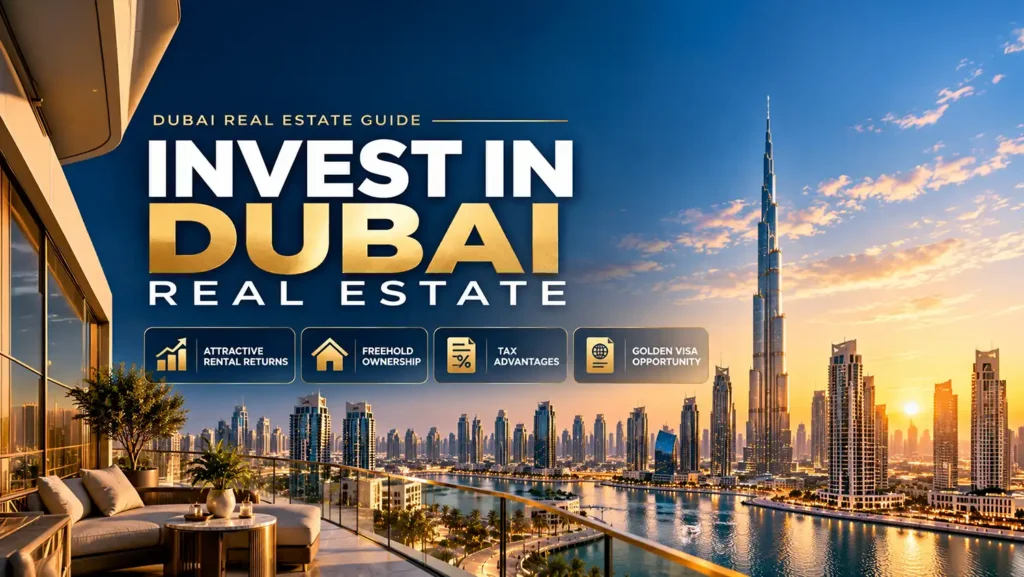
Dubai recorded AED 686.8 billion in property transactions during 2025, a 30.9% increase over the previous year and the highest annual figure the market has ever produced. Over 215,000 individual deals closed, with off-plan sales alone accounting for 149,000 of them. Yet those aren’t numbers driven by hype. They reflect sustained demand from international investors, end-users relocating to the UAE, and residents upgrading within the city. If you’re considering whether to invest in Dubai real estate for the first time, the market has never been more active, but it’s also never required more clarity about where to put your money and how the process actually works.
This guide walks through every step a first-time investor needs: the actual fees you’ll pay, which areas deliver the strongest rental yields in 2026, how mortgage financing works for residents and non-residents, and the Golden Visa pathway that comes with property ownership above AED 2 million. Whether you’re exploring why buy property in dubai or you’ve already decided and need the mechanics, everything is here.
Why Invest in Dubai Real Estate in 2026
Naturally, people ask why invest in Dubai and the honest answer is that the fundamentals haven’t weakened in five years. Since 2020, total property transaction value has grown from AED 71.5 billion to AED 686.8 billion. Indeed, that’s not a typo. Essentially, it’s an 861% increase in cumulative market value over half a decade, driven by population growth, visa reforms, zero income tax, and a regulatory system that genuinely protects foreign investors.
Still, “the market is up” isn’t a reason to invest. Here’s what actually makes Dubai property investment different from other global cities:
- Zero income tax on rental income: In fact, there’s no capital gains tax, no property tax, and no annual wealth tax. Your gross yield is closer to your net yield than in almost any other major city.
- Golden Visa at AED 2 million: Acquiring property valued at AED 2 million or above qualifies you for a 10-year renewable residency visa, no employer sponsor required. In addition, it covers your spouse, children, and domestic staff.
- Regulated escrow for off-plan: Dubai’s Real Estate Regulatory Agency (RERA) requires developers to deposit investor payments into escrow accounts monitored by the Dubai Land Department. Your money doesn’t go directly to the developer’s operating account.
- Freehold ownership for all nationalities: As a result, foreign nationals can own freehold property in designated zones across the city and the list of zones is long.
- Strong rental demand: Dubai’s population grew by over 100,000 residents in 2024 alone. More people means more lease demand, and vacancy rates in popular communities remain tight.
Of course, none of this means every property is a good investment. Rather, it means the structural conditions, tax, regulation, demand, residency are aligned in a way few cities can match. Ultimately, the returns depend entirely on what you acquire, where, and at what entry point.
Why should you invest in Dubai real estate?
Dubai offers zero income tax on rental yields, a 10-year Golden Visa through property ownership above AED 2 million, RERA-regulated escrow accounts for off-plan acquisitions, and freehold ownership open to all nationalities. The market recorded AED 686.8 billion in transactions during 2025, reflecting strong and sustained demand from both residents and international investors.
Property Investment in Dubai: Understanding the Market Structure
Before you look at specific areas or buildings, first understand how Dubai’s property market is structured. It splits into two distinct segments and each one serves a different investment strategy.
Ready (Secondary Market) vs Off-Plan
Generally, ready properties are completed units you can inspect, move into, or lease out immediately. In 2025, resale transactions hit AED 238.8 billion across 66,446 deals, with per-square-foot values growing 11.3% year-on-year. As a result, the advantage of ready property is simple: you see what you’re acquiring, you can verify the building’s condition, and rental income starts from day one.
By contrast, off-plan properties are units still under construction, purchased directly from developers. In fact, this segment dominated 2025 with 149,290 transactions worth AED 448.1 billion. Specifically, off-plan appeals to investors because developers offer payment plans spread over construction timelines, often 60/40 or 70/30 splits meaning you don’t need the full amount upfront. However, you’re committing capital to a project that won’t generate income until handover, and there’s execution risk if the developer underperforms.
For first-time investors, ready property is generally the safer starting point. Essentially, you eliminate construction delay risk, start earning rental income immediately, and can physically inspect the unit and its building management. Then, once you understand the market, off-plan becomes a tool for capital appreciation, acquiring at today’s value for delivery at tomorrow’s market rate.
Freehold vs Leasehold: What Can You Actually Own?
Currently, Dubai designates specific zones where foreign nationals can hold freehold title, full ownership with no expiry. Major freehold areas include Dubai Marina, JVC, Business Bay, Downtown Dubai, Dubai Hills Estate, Palm Jumeirah, Dubai Creek Harbour, and JLT. Beyond these zones, leasehold arrangements (typically 99 years) apply.
For a complete breakdown of how these structures work and which areas fall into each category, see our freehold vs leasehold property guide for Dubai.
Step-by-Step: How to Acquire Your First Property in Dubai
Below is the actual process, from budgeting to collecting your title deed. In practice, each step has specific requirements that first-time investors often miss.
Step 1 – Set Your Total Budget (Not Just the Property Value)
Importantly, the asking value of the property isn’t your total outlay. In practice, transaction fees add roughly 7–8% for mortgage-backed acquisitions and 6–6.5% for cash purchases. On a AED 1.5 million apartment, that’s AED 105,000–120,000 in additional fees on top of your initial amount. Therefore, budget for the full number before you start viewing.
Step 2 – Get Mortgage Pre-Approval (If Financing)
If you’re financing, get pre-approved before you start searching. Generally, pre-approval is typically valid for 60 days and tells you exactly how much the bank will lend. Otherwise, you risk falling in love with a property you can’t afford or losing it to a cash buyer while your application processes.
Currently, the best fixed mortgage rates in Dubai sit between 3.78% and 4.25% for a two-to-three-year fixed term. After the fixed period, rates convert to EIBOR (currently around 3.75%) plus a margin. Standard Chartered, ADCB, and DIB are consistently among the most competitive for salaried expat residents.
Step 3 – Choose Your Area and Property Type
Truthfully, this is where most first-time investors either get it right or waste months. Instead, don’t start with buildings, start with your investment goal. Specifically, cash-flow investors should focus on high-yield areas (JVC, International City, Discovery Gardens). Meanwhile, capital appreciation investors should look at growth corridors (Dubai Creek Harbour, Dubai Hills, MBR City). We’ll cover specific areas and their returns in detail below.
Step 4 – Engage a RERA-Registered Agent
Always work only with agents registered with the Real Estate Regulatory Agency (RERA). You can verify any agent’s licence on the DLD REST app. In practice, a good agent will confirm the title deed status, check for outstanding service charges, explain the fee structure transparently, and handle the paperwork through to transfer.
Step 5 – Sign Form F (Memorandum of Understanding)
During this stage, buyer and seller sign Form F, the binding agreement that locks in the terms. At this point, the buyer also typically pays a 10% security deposit held in trust. Generally, the standard timeline from Form F to transfer is 30–45 days, though mortgage-backed acquisitions can take longer.
Step 6 – Complete the Transfer at DLD
Once the bank issues the final loan offer (for financed acquisitions) and the developer issues a No Objection Certificate (NOC), both parties attend a DLD Registration Trustee office. Specifically, you’ll bring manager’s cheques for the property value, the 4% DLD fee, agency professional fee, and trustee charges. After verification, the title deed then transfers to your name and you officially own property in Dubai.
How do you buy property in Dubai as a first-time investor?
Set your total budget including 7–8% in transaction fees, get mortgage pre-approval if financing, choose your target area based on investment goals, engage a RERA-registered agent, sign Form F (MoU) with a 10% security deposit, and complete the transfer at a DLD Registration Trustee office with manager’s cheques. The process typically takes 30–45 days from Form F to title deed.
Every Fee You’ll Pay: The Full Cost Breakdown
Frequently, first-time investors are surprised by how much sits on top of the listed value. Below is the complete fee structure for a Dubai property acquisition in 2026.
| Fee Type | Amount | Who Pays |
|---|---|---|
| DLD transfer fee | 4% of property value | Buyer (legally 50/50, but buyer pays in practice) |
| Registration trustee fee | AED 4,000 + VAT (property above AED 500K) | Buyer |
| Title deed issuance | ~AED 580 | Buyer |
| Agency professional fee | 2% + VAT | Buyer |
| Mortgage registration (if financing) | 0.25% of loan + AED 290 | Buyer |
| Bank valuation (if financing) | AED 2,500–3,500 + VAT | Buyer |
| Bank processing fee (if financing) | ~1% of loan amount | Buyer |
| Developer NOC fee | AED 500–5,000 (varies by developer) | Seller (often negotiated) |
On a AED 1.5 million apartment acquired with a mortgage, expect total fees of approximately AED 120,000–130,000. By comparison, cash acquisitions reduce this to around AED 100,000–105,000 by eliminating the mortgage registration, valuation, and processing charges. Either way, however, budgeting 7–8% above the property value keeps you safe from surprises.
For a deeper understanding of how property valuations work within DLD’s system, our guide to Taqeemi property valuation in Dubai explains the process and its role in mortgage approvals.
Best Property Investment in Dubai: Rental Yields by Area (2026)
Ultimately, where you invest matters more than when you invest. In real terms, the difference between a 5% yield and a 10% yield is the difference between covering your mortgage and generating real passive income. Below are the areas that currently deliver the strongest returns for property investment in Dubai.
| Area | Avg. Value per Sq Ft (AED) | YoY Appreciation | Gross Rental Yield |
|---|---|---|---|
| International City | 480 | +6.8% | 10.5% |
| Jumeirah Village Circle (JVC) | 850 | +8.5% | 10.2% |
| Business Bay | 1,650 | +10.8% | 8.2% |
| Dubai Hills Estate | 1,450 | +14.2% | 7.8% |
| Dubai Marina | 1,850 | +12.3% | 7.5% |
| Dubai Creek Harbour | 1,350 | +16.8% | 7.0% |
| Downtown Dubai | 2,400 | +15.2% | 6.8% |
| Palm Jumeirah | 3,200 | +18.5% | 5.5% |
Which Areas Suit First-Time Investors?
For cash-flow-focused investors acquiring their first property, JVC stands out. At AED 850 per square foot, specifically, and a gross yield above 10%, a one-bedroom apartment here runs approximately AED 700,000. As a result, gross rental income on that unit sits around AED 71,000 per year. After service charges, maintenance, and occasional vacancy, net returns of 7.5–8.5% are realistic. On top of that, JVC led all Dubai communities in transaction volume during 2025, with over 18,000 deals, proof that liquidity isn’t a concern when it’s time to exit.
For investors who want both yield and appreciation, Business Bay and Dubai Hills Estate offer the best balance. In particular, Business Bay’s central location and proximity to Downtown Dubai support consistent lease demand from professionals, while its 10.8% year-on-year appreciation adds capital growth. Likewise, Dubai Hills Estate has emerged as one of the most sought-after family communities; its green spaces, international schools, and mall proximity drive both owner-occupier and lease demand.
If capital appreciation is your primary goal and you’re comfortable with a lower yield, Dubai Creek Harbour and Palm Jumeirah deserve attention. Specifically, Creek Harbour posted 16.8% appreciation in 2025 with significant future development still planned around the Dubai Creek Tower site. Palm Jumeirah, at AED 3,200 per square foot, targets ultra-premium investors, but its 18.5% appreciation and trophy-asset status make it a store of value that few global markets can match.
What is the best area for property investment in Dubai in 2026?
For rental yield, JVC (10.2% gross) and International City (10.5% gross) lead. When it comes to balanced yield and appreciation, Business Bay (8.2% yield, 10.8% appreciation) and Dubai Hills Estate (7.8% yield, 14.2% appreciation) perform well. For capital growth, Dubai Creek Harbour (+16.8%) and Palm Jumeirah (+18.5%) offer the strongest upside. The best area depends on whether your priority is monthly income or long-term value growth.
Mortgage Rules for First-Time Investors in Dubai
Currently, financing property in Dubai follows strict rules set by the UAE Central Bank. Therefore, understanding these rules before you start searching prevents wasted time on properties outside your borrowing capacity.
How Much Can You Borrow?
For your first ready property valued under AED 5 million, UAE banks can lend up to 80% of the value, meaning you need a minimum 20% initial amount. Above AED 5 million, however, the maximum loan-to-value drops to 70%, requiring 30% upfront. For second and subsequent properties, the cap drops further to 60% LTV, requiring 40% upfront. Meanwhile, off-plan mortgages are capped at 50% LTV regardless of value.
By contrast, UAE nationals get slightly better terms, up to 85% LTV on a first property under AED 5 million. Generally, non-residents typically qualify for 70–75% LTV. And your total debt-burden ratio, all monthly obligations including the proposed mortgage, can’t exceed 50% of your gross monthly income.
What Are Current Mortgage Rates?
As of mid-2026, the best fixed rates for salaried expat residents sit between 3.78% and 4.25% for two-to-three-year fixed terms. After the fixed period, however, rates revert to the 3-month EIBOR (currently around 3.75%) plus a margin that typically ranges from 1.09% to 1.99%, depending on the bank.
Something unusual is happening in the current market: fixed rates are actually lower than variable rates. Entry-level fixed rates at 3.78–3.85% sit below variable rates of 5.25–5.65%. As a result, this inversion means locking in a fixed rate right now is mathematically advantageous, you’re paying less than you would on a floating rate while getting payment certainty.
Still, one important caveat for first-time investors: several major banks tightened lending criteria in early 2026. At least seven lenders effectively reduced their funded LTV from 80% to 70% during Q1 2026, meaning you may need a larger initial amount than the headline rules suggest. Therefore, always confirm the funded LTV, not just the advertised maximum with your specific bank before committing.
Documents You’ll Need for Pre-Approval
Generally, banks typically require a salary certificate from your employer, six months of bank statements, a credit report from the Al Etihad Credit Bureau (AECB), and copies of your passport, Emirates ID, and residency visa. By contrast, self-employed applicants face additional requirements, usually two years of audited financials and trade licence documentation and may pay 0.20–0.40% more on their rate.
Ready to explore your first Dubai property investment? Our advisors can walk you through areas, budgets, and financing options. Speak with Divine Living
The Golden Visa Pathway Through Property
Perhaps one of the strongest reasons to invest in Dubai real estate above the AED 2 million mark is the 10-year Golden Visa. Below is exactly how it works and what qualifies.
What’s the AED 2 Million Threshold?
Importantly, the threshold is based on the total registered value of the property, not your upfront cash payment. Therefore, if you acquire a AED 3 million apartment with an 80% mortgage, you still qualify because the property’s registered value exceeds AED 2 million. What’s more, you can combine multiple properties to reach the threshold, provided all title deeds are fully or partly in your name.
Similarly, off-plan properties under construction can qualify too. You’ll need the purchase agreement registered with the Dubai Land Department and a developer statement showing at least AED 2 million committed. As a result, you can start the Golden Visa process before handover.
What Does the Golden Visa Include?
Specifically, the 10-year visa is renewable and doesn’t require a national sponsor. It covers your spouse, children, and domestic staff. Equally, there are no restrictions on time spent outside the UAE, you won’t lose your residency if you travel extensively. Application fees run approximately AED 5,290 for standard processing (7–10 business days) or AED 6,280 for fast-track (3–5 business days).
For many international investors, the Golden Visa transforms property investment in Dubai from a pure financial play into a lifestyle decision. You’re not just acquiring an asset, you’re gaining residency in a zero-tax jurisdiction with global connectivity.
Can you get a Golden Visa by acquiring property in Dubai?
Yes. Acquiring property valued at AED 2 million or more qualifies you for a 10-year renewable Golden Visa. The threshold is based on registered property value, not cash paid, so mortgaged properties qualify. You can combine multiple properties to reach AED 2 million. Off-plan properties also qualify if the purchase agreement is registered with DLD and shows AED 2 million committed.
Why to Invest in Dubai Real Estate: The Numbers Behind the Case
Honestly, abstract arguments about “growth” and “opportunity” don’t close deals. Only numbers do. Below is what actual returns look like for a first-time investor in 2026, using real market data.
Scenario 1: Cash-Flow Investment in JVC
Acquiring a one-bedroom apartment in JVC at AED 700,000, paying cash, no mortgage. Annual gross rental income: approximately AED 71,000 (10.2% gross yield). After service charges of roughly AED 15 per square foot (approximately AED 11,000 annually), maintenance reserve, and one month of vacancy, net income lands around AED 55,000–58,000 per year. That’s a net yield of roughly 8.0–8.3%. In a city with zero income tax on that rental income, the effective return exceeds what most European or North American rental markets deliver at twice the investment.
Scenario 2: Growth-Plus-Yield in Dubai Hills Estate
A two-bedroom apartment in Dubai Hills Estate at AED 2.9 million financed with a 20% initial amount (AED 580,000) and an 80% mortgage at 4% fixed. Annual gross rental income: approximately AED 226,000 (7.8% yield). As a result, monthly mortgage payment on a AED 2.32 million loan at 4% over 25 years: roughly AED 12,200. After mortgage payments, service charges, and maintenance, net cash flow is modest, perhaps AED 20,000–30,000 annually. However, the capital appreciation of 14.2% year-on-year adds AED 411,000 in paper value during year one alone. Over five years, consequently, the combination of leveraged appreciation plus accumulated rental income can push total returns well above the initial cash invested.
Scenario 3: Golden Visa + Premium Asset on Palm Jumeirah
A two-bedroom on Palm Jumeirah at AED 5.5 million cash purchase. Annual gross rental income: approximately AED 302,000 (5.5% yield). After all deductions, net income sits at approximately AED 250,000–260,000. Certainly, yield is lower than JVC, but you’re holding a trophy asset that appreciated 18.5% in 2025. As a bonus, you qualify for the Golden Visa, your family gets residency, and you hold an asset class that historically retains value even during downturns. Palm Jumeirah values barely dipped during the 2020 slowdown while less established areas dropped 10–15%.
Common Mistakes First-Time Investors Make in Dubai
Based on experience with dozens of first-time investors, certain errors appear repeatedly. In practice, avoiding even one of these can save you tens of thousands of dirhams.
Ignoring service charges until after the acquisition. In reality, service charges vary wildly between buildings even within the same community. For instance, a tower in Business Bay might charge AED 12 per square foot annually, while the building next door charges AED 22. On a 900-square-foot apartment, that’s a difference of AED 9,000 per year, which directly eats into your yield. Therefore, request the service charge statement before signing anything.
Chasing yield without checking liquidity. True, International City offers 10.5% gross yield, the highest in Dubai. However, its per-square-foot value of AED 480 and limited appeal to premium residents mean resale can take longer. If you need to exit within two to four years, a lower-yield area with higher liquidity (like Dubai Marina or Business Bay) may protect your capital better.
Financing and Timing Errors
Starting the property search before getting pre-approved. Without pre-approval, essentially, you don’t know your actual borrowing limit. Banks assess your debt-burden ratio, credit history, and salary stability, not just your income. As a result, getting pre-approved first narrows your search to properties you can actually close on, and sellers take pre-approved buyers more seriously.
Assuming the listed LTV is what you’ll get. On paper, the UAE Central Bank sets maximum LTV rules, but individual banks can and do impose stricter limits. In early 2026, at least seven major lenders reduced their funded LTV from 80% to 70%. In practice, that means a 20% initial amount budget might actually need to be 30%. Therefore, confirm your funded LTV in writing before relying on it.
Overlooking the NOC process. Equally, the developer’s No Objection Certificate is required for every resale transfer. Specifically, developers won’t issue it if the current owner has unpaid service charges and resolving outstanding charges can add weeks to your timeline. Accordingly, check for outstanding service charge disputes before signing Form F.
What mistakes should first-time investors avoid in Dubai?
The most common errors include ignoring service charges (which vary by thousands of dirhams between buildings), skipping mortgage pre-approval before searching, assuming the headline 80% LTV is guaranteed (several banks now cap at 70%), and overlooking the NOC process which can delay transfers if the seller has unpaid service charges. Budget for total costs of 7–8% above property value.
Buy Property in Dubai for Investment: Off-Plan vs Ready – Which Strategy Wins?
Clearly, both strategies have delivered strong returns in recent years. Yet they serve different investor profiles, and mixing them up is where first-time investors get burned.
When Off-Plan Makes Sense
Typically, off-plan works best when you have limited upfront capital and a long time horizon. In most cases, developers structure payment plans with 10–20% at booking, installments during construction, and 30–40% at handover. On a AED 1.2 million apartment with a 60/40 plan, you’d pay AED 720,000 during construction and AED 480,000 at handover. If the market appreciates 10% during the two-year construction period, your unit is worth AED 1.32 million at handover, a AED 120,000 paper gain on AED 720,000 invested, or roughly 16.7% return on capital deployed.
That said, off-plan carries risks that ready property doesn’t. First, construction delays push back your income timeline. Second, market corrections during the build period can leave you completing a purchase at above-market value. Third, the 50% LTV cap on off-plan mortgages means financing is more restrictive.
When Ready Property Makes Sense
On the other hand, ready property suits investors who want immediate rental income, can inspect the actual unit and building, and prefer the certainty of acquiring at a known market value. For first-time investors, ready property removes the biggest variable: uncertainty. Specifically, you know the exact condition of the unit, the actual service charges, the building’s management quality, and the real-world lease rates in that community, not projected figures from a developer’s brochure.
However, the trade-off is that ready property requires more capital upfront. You’re paying today’s market value in full (or financing at 80% LTV), versus an off-plan payment plan that spreads outlays over two to four years. Yet in exchange, your asset generates income from month one.
Dubai Investment Real Estate: Tax Advantages That Compound Over Time
Without question, Dubai’s tax position is one of its strongest selling points, but most first-time investors underestimate how much it actually changes their returns versus other global markets.
What You Don’t Pay
Simply put, Dubai has no annual property tax, no income tax on rental income, and no capital gains tax when you sell. By contrast, compare that to London (where rental income is taxed at up to 45% and capital gains at up to 28%), New York (property taxes of 1–2% annually plus income tax on rental income), or Singapore (property tax plus additional buyer’s stamp duty for foreigners of up to 60%).
To illustrate, on a property generating AED 100,000 in annual rental income, a Dubai investor keeps the full AED 100,000 (minus operating costs). Meanwhile, a London investor in the higher rate band keeps roughly AED 55,000–60,000 after tax. Over ten years, consequently, that difference compounds to hundreds of thousands of dirhams in retained income. In effect, the tax saving alone can fund your next acquisition.
VAT on Property
Generally, residential property in Dubai is exempt from VAT. In particular, there’s no VAT on the sale or lease of residential units. However, commercial property is subject to 5% VAT, which matters if you’re considering office or retail investments. For first-time residential investors, VAT isn’t a factor in your calculations.
How to Choose the Right Property Type for Your First Investment
Between studios, one-bedrooms, two-bedrooms, and villas, each serves a different market segment and delivers different returns. Each serves a different segment. Here’s how to think about it.
Studios and One-Bedrooms: Maximum Yield
As a rule, smaller units deliver the highest rental yields because per-square-foot lease rates are higher for compact spaces. A studio in JVC generating AED 42,000 annual lease income on a AED 430,000 investment gives you a 9.8% gross yield. Similarly, one-bedrooms follow the same pattern. If your goal is cash flow first and you’re working with a budget under AED 800,000, studios and one-bedrooms in high-demand areas are the most efficient use of your capital.
Two-Bedrooms: The Sweet Spot
Typically, two-bedroom apartments attract families and couples, residents who tend to sign longer leases and renew more reliably than studio occupants. As a result, turnover costs (cleaning, minor repairs, re-leasing fees) eat into your returns with every changeover. A two-bedroom in Dubai Hills Estate that rents to a family for two to four years will outperform a studio in the same building that turns over annually, even if the studio’s headline yield is higher. For first-time investors with a budget of AED 1.2–3.0 million, two-bedrooms offer the best balance of yield, appreciation, and lease stability.
Villas: Lower Yield, Stronger Appreciation
Historically, Dubai’s villa market delivered some of the strongest appreciation in 2025, up to 29% in premium communities. However, gross yields on villas typically sit 1–2 percentage points below apartments. On top of that, villas carry higher maintenance obligations and service charges. For first-time investors, apartments are a simpler, more liquid entry point. Instead, villas make sense as a second or third acquisition once you understand the market’s rhythms.
Best Real Estate Investment in Dubai: Location Factors That Drive Returns
Interestingly, two properties in the same community can deliver wildly different returns. Beyond the area itself, these specific factors determine whether an individual unit is the best real estate investment in Dubai for your situation.
Metro proximity: As a rule, properties within walking distance of a Dubai Metro station consistently command 10–15% higher lease rates than comparable units further away. When the Route 2020 extension opened in Dubai South, nearby property values jumped measurably. So if a new metro line is planned near your target area, that’s a forward-looking appreciation signal.
Building management quality: Without exception, well-managed buildings retain value. Poorly managed ones don’t. Before committing, therefore, visit the building’s common areas, check the condition of lifts, corridors, parking, and the swimming pool. Ask current residents about responsiveness to maintenance requests. After all, a building with peeling paint and broken gym equipment is a building where residents leave and departing residents mean vacancy.
Floor, View, and Developer Reputation
Floor and view: Generally, higher floors with open views command 5–15% premiums on both value and lease rate in the same building. A 15th-floor unit facing the Burj Khalifa in Business Bay will outperform a 3rd-floor unit facing the car park. Given that, when two units are similarly priced, always take the higher floor with the better view.
Developer reputation: Historically, properties by Emaar, Nakheel, Dubai Properties, Meraas, and Sobha consistently trade at premiums versus smaller developers. What’s more, they hold value better during downturns. For first-time investors, sticking with established developers reduces execution risk and resale uncertainty.
Upcoming Infrastructure and Its Effect on Values
Specifically, keep an eye on planned infrastructure within a 2-kilometre radius of any property you’re considering. Dubai’s track record shows that metro station openings, mall completions, and school launches consistently lift both lease rates and resale values within 12–18 months of completion. Areas like Dubai South, which will host the expanded Al Maktoum International Airport, and MBR City, positioned along the planned metro extension, represent forward-looking opportunities where current values haven’t yet priced in confirmed infrastructure spending. Of course, infrastructure-led appreciation isn’t guaranteed, but Dubai’s government has a strong delivery record on announced projects.
For a broader perspective on what makes Dubai property appealing across investor types, from end-users to institutional capital, our overview of the benefits of investing in dubai real estate covers the macro case in full. Equally, if you’re exploring why to buy property in dubai, that guide breaks down the long-term case alongside the 2026 numbers.
Need guidance on finding the best real estate investment in Dubai for your budget? Our team analyses areas, buildings, and units to match your goals. Get in touch with Divine Living
Comparing Dubai to Other Global Property Markets
Frequently, first-time investors weigh Dubai against London, Singapore, New York, or Istanbul. Below is how Dubai stacks up on the metrics that actually matter for returns.
| Factor | Dubai | London | Singapore | New York |
|---|---|---|---|---|
| Gross rental yield | 5.5–10.5% | 2.5–4.0% | 2.0–3.5% | 2.5–4.5% |
| Income tax on rental | 0% | Up to 45% | Up to 22% | Up to 37% |
| Capital gains tax | 0% | Up to 28% | 0% (for individuals after 3 yrs) | Up to 20% |
| Annual property tax | None | Council tax | 0.04–0.16% | 0.8–1.9% |
| Foreign buyer stamp duty | None | 2–12% SDLT | Up to 60% ABSD | 1–2.5% mansion tax |
| Residency via property | Yes (AED 2M+) | No (Tier 1 closed) | No | No (EB-5 separate) |
Honestly, the comparison isn’t even close on an after-tax basis. A Dubai property yielding 8% gross delivers 8% net (minus operating costs). By contrast, a London property yielding 4% gross might deliver 2.2% net after income tax, council tax, and management fees. Over a ten-year hold, accordingly, that gap translates to hundreds of thousands of dirhams in additional retained income.
If you’re also evaluating Sharjah as an alternative or complement to Dubai, our Sharjah vs Dubai property comparison breaks down the yield, fee, and ownership differences between the two emirates.
After the Acquisition: Managing Your Dubai Property
Clearly, acquiring the property is step one. After that, managing it well is what determines whether your actual returns match your projections.
Self-Management vs Property Management Companies
Generally, if you’re a Dubai resident and own one to two units, self-management is feasible. You’ll handle resident screening, lease agreements (via Ejari registration), maintenance coordination, and lease income collection. As a result, the upside is keeping the full rental income without paying management fees.
For non-resident investors or those owning multiple units, a property management company makes more sense. Typically, fees run 5–8% of annual rental income. In practice, a good management company handles everything from resident screening to maintenance emergencies, DEWA connections, Ejari registration, and lease renewals. Above all, the key metric is their vacancy rate, ask for portfolio-wide figures, not just their best-performing buildings.
Ejari Registration: Not Optional
By law, every lease contract in Dubai must be registered through the Ejari system managed by the DLD. Without it, neither the property owner nor the resident can access certain government services. Equally, it protects both parties legally. Currently, registration costs AED 220 plus a small service fee, and it takes minutes to complete online.
DEWA and Service Charge Obligations
As the property owner, naturally, you’re responsible for annual service charges to the building’s management or homeowner association. Ordinarily, the resident pays DEWA (electricity and water) directly. That said, if the unit sits vacant between residents, DEWA charges come back to you. Therefore, budget for one to two months of vacancy per year in your financial model, even in high-demand areas, turnover gaps happen.
Frequently Asked Questions
Minimum cash required depends on your approach. For a cash acquisition, budget the full property value plus 6–6.5% in fees. For a financed acquisition, you need at least 20% of the property value as an initial amount (for properties under AED 5 million) plus 7–8% in fees. A AED 700,000 apartment in JVC with 80% financing requires approximately AED 195,000–200,000 upfront (initial amount plus fees).
Dubai’s 2025 transaction record of AED 686.8 billion, sustained population growth, zero income tax on rental yields, and rental yields of 5.5–10.5% across different areas suggest strong fundamentals. However, entry timing, area selection, and property type matter significantly. High-yield areas like JVC and International City suit cash-flow investors, while premium areas like Palm Jumeirah and Dubai Hills suit growth-focused strategies.
Yes. Non-residents can own freehold property in Dubai’s designated zones without needing a UAE visa or residency. Mortgage financing is available for non-residents at 70–75% LTV. Acquiring property valued at AED 2 million or more qualifies for a 10-year Golden Visa, converting a non-resident investor into a UAE resident.
Annual holding costs include service charges (AED 12–25 per square foot depending on the building), DEWA utility deposits (refundable), building insurance (often included in service charges), and any maintenance or repairs. There’s no annual property tax. For a typical one-bedroom apartment, annual holding costs run AED 10,000–18,000 excluding any mortgage payments.
From signing Form F (the binding MoU) to receiving your title deed, the process typically takes 30–45 days. Cash acquisitions can complete faster sometimes within two weeks if the NOC and DLD appointment are expedited. Mortgage-backed acquisitions take longer due to bank valuation, loan processing, and mortgage registration steps. Factor in one to two weeks for mortgage pre-approval before you start searching.
One-bedroom and two-bedroom apartments in established freehold communities offer the best combination of yield, liquidity, and manageable capital requirements for first-time investors. Studios maximise yield but have higher turnover. Villas offer stronger appreciation but require more capital and carry higher maintenance obligations. Most first-time investors start with a one-bedroom or two-bedroom apartment and expand from there.
No. Non-residents can own, lease out, and sell Dubai property without living in the UAE. Many international investors manage their properties through licensed property management companies for 5–8% of annual rental income. Non-residents can also obtain mortgage financing from UAE banks, though at slightly lower LTV ratios (70–75% versus 80% for residents).
As of mid-2026, the best fixed mortgage rates for salaried expat residents range from 3.78% to 4.25% for two-to-three-year fixed terms. After the fixed period, rates convert to EIBOR plus a margin. Variable rates currently sit higher at 5.25–5.65%. Standard Chartered, ADCB, and DIB consistently offer the most competitive rates for first-time acquisitions.