Property in Sharjah vs Dubai: What Costs Less, Earns More, and Who Can Actually Own
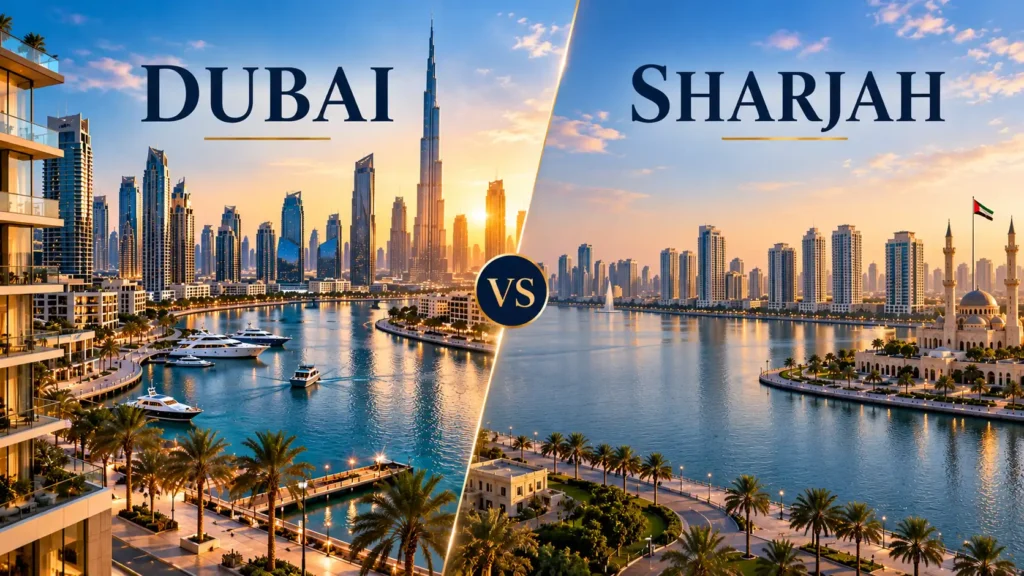
Sharjah real estate has quietly become one of the most talked-about opportunities in the UAE. While Dubai captures the global headlines, Sharjah recorded AED 7.3 billion in property transactions during the first half of 2025 alone, a 48.1% jump year-on-year. Yet apartment values in Sharjah still sit 30–40% below comparable units across the Dubai border. So the question isn’t whether Sharjah is worth a look. It’s whether Sharjah or Dubai fits your specific situation better, and what you’d actually gain or lose by choosing one over the other.
This guide breaks down the real numbers: property prices by area, rental yields that reach 8%+ in certain Sharjah neighbourhoods, registration fees that differ by thousands of dirhams, and the ownership rules that changed after Sharjah’s Law No. (2) of 2022 opened the door to foreign nationals. If you’re weighing benefits of buying property in dubai against what Sharjah now offers, everything you need is below.
Why Sharjah Real Estate Deserves a Serious Look in 2026
For years, Sharjah was the emirate people lived in and commuted from a bedroom community for Dubai workers who wanted lower lease payments. But that perception is outdated. Since the Sharjah Executive Council removed nationality restrictions on property ownership, the market has shifted from a local-only affair to one that attracts international capital.
Consequently, transaction volumes have surged. Apartment values in popular areas like Al Nahda rose 21% in a single year. As a result, villa communities such as Tilal City and Aljada are selling out phases before completion. Meanwhile, Sharjah’s 2% registration fee, half of Dubai’s 4% means the entry barrier is lower by tens of thousands of dirhams on a mid-range apartment.
Still, Sharjah isn’t trying to be Dubai. Specifically, it won’t offer the same nightlife, short-term holiday-home flexibility, or metro coverage. Understanding what each emirate does well and where each one falls short is the entire point of this comparison.
Sharjah Property Market Performance: The Numbers Behind the Growth
Before comparing the two emirates side by side, it’s worth understanding why Sharjah’s market is moving at this pace. In 2024, apartment lease rates across the emirate rose by up to 28%, while villa lease payments climbed as much as 31%. Importantly, these aren’t speculative numbers driven by off-plan flipping, they reflect genuine resident demand.
Several factors are driving that demand simultaneously. First, Dubai’s own success is pushing budget-conscious residents east. Once Dubai apartment values climbed 10% in 2025, families priced out of areas like JVC, Al Barsha, and Dubai Silicon Oasis started looking across the border. Second, Sharjah’s new ownership laws opened the market to international investors who previously had no legal pathway to acquire here. Third, master-planned communities like Aljada and Tilal City are offering product quality that didn’t exist in Sharjah five years ago.
Consequently, the Al Mamzar apartment segment saw values rise 23% in a single year. Al Nahda followed closely with a 21% increase. Even established areas that hadn’t seen meaningful movement in years like Al Majaz and Al Taawun posted 6–8% gains. When multiple areas move simultaneously rather than just one hot pocket, that signals broad-based demand rather than localised speculation.
How Does Sharjah’s Growth Compare to Dubai’s Track Record?
Dubai’s market is roughly 60 times larger by transaction volume. That scale means Dubai will always absorb more international capital and offer deeper liquidity. Yet Sharjah’s 48.1% year-on-year transaction growth outpaced Dubai’s rate in the same period. Smaller markets can move faster precisely because they’re starting from a lower base and that’s where the opportunity sits for investors who get in early.
Still, there’s a distinction between growth and maturity. Dubai’s secondary market has decades of transaction history, established escrow processes, and a global reputation that makes resale straightforward. Sharjah is building that infrastructure now. If you need certainty about your exit timeline, Dubai provides it. If you’re willing to hold for five to ten years and collect strong yields while the market matures, Sharjah offers a more compelling entry point.
Sharjah vs Dubai Property Investment: A Side-by-Side Breakdown
With that context established, here’s the broad comparison. These figures come from Bayut’s 2025 market report, SRERD transaction data, and Dubai Land Department records.
| Factor | Sharjah | Dubai |
|---|---|---|
| Average apartment value per sq ft | AED 524–1,041 | AED 1,200–2,500+ |
| 2-bedroom apartment (mid-range area) | AED 690,000–1,190,000 | AED 1,200,000–2,000,000+ |
| 3-bedroom villa | AED 1,930,000–2,240,000 | AED 3,000,000–6,000,000+ |
| Gross rental yield (apartments) | 5.3%–8.8% | 5.0%–7.5% |
| Registration / transfer fee | ~2% (SRERD) | 4% (DLD) |
| Foreign freehold ownership | Designated zones only | Wide range of freehold zones |
| H1 2025 transaction volume | AED 7.3 billion | AED 431 billion |
| Lifestyle profile | Family-oriented, cultural, affordable | Cosmopolitan, luxury-focused |
The gap in transaction volume tells you something about market depth. In other words, Dubai’s secondary market is far more liquid, you’ll find a buyer faster when you’re ready to exit. However, Sharjah’s yield advantage of 1–2 percentage points on apartments means your monthly returns can beat Dubai from day one, especially in value-oriented areas like Al Nahda, Al Qasimia, and Abu Shagara.
Is Sharjah property cheaper than Dubai?
Yes. Sharjah property values are typically 30–40% lower than comparable units in Dubai. A two-bedroom apartment in Sharjah’s Al Nahda area averages around AED 690,000, while a similar unit in Dubai’s Al Nahda starts closer to AED 1,200,000. Registration fees are also lower, 2% in Sharjah versus 4% in Dubai which reduces total acquisition costs further.
Apartments for Sale in Sharjah: Where to Look and What to Expect
If you’re searching for apartments for sale in Sharjah, the market splits into two tiers. Established areas like Al Nahda, Al Qasimia, and Abu Shagara offer older buildings at lower price points with some of the strongest rental returns in the entire UAE. On the other hand, newer master-planned communities like Aljada, Maryam Island, Al Mamsha, command higher values per square foot but come with modern amenities and developer-backed finishes.
Budget-Friendly Areas (Under AED 750,000 for a 1-Bed)
Al Nahda leads the pack for value-conscious investors. Currently, one-bedroom apartments average AED 470,000 here, with gross yields reaching 7.9%. Because Al Nahda sits on the Sharjah-Dubai border, many residents work in Dubai and lease in Sharjah for the savings. As a result, that border-proximity demand keeps vacancy rates low.
Similarly, Al Qasimia offers one-bedroom flats around AED 500,000 with the highest gross yield in Sharjah at 8.8%. Certainly, the area is older and won’t impress anyone looking for resort-style pools or concierge lobbies. But if your strategy is cash-flow-first, Al Qasimia’s numbers are hard to argue with.
Mid-Range and Upscale Areas
Al Khan, the waterfront stretch facing the Arabian Gulf, averages AED 971 per square foot, up 9% year-on-year. Currently, one-bedroom units here average AED 699,000. Yields are lower (3.88% ROI per Bayut’s data), but capital appreciation has been consistent, and Maryam Island’s ongoing development is pulling the entire Al Khan corridor upward.
Aljada, Sharjah’s largest mixed-use master plan, prices one-bedroom apartments at roughly AED 747,000 with a 6.17% ROI. In fact, it’s the community most frequently compared to Dubai’s Town Square or Dubai Hills, with parks, retail, and a dedicated entertainment zone. For investors who want modern product at Sharjah values, Aljada is the obvious starting point.
Overall, whether you’re looking at a flat for sale in Sharjah under AED 500,000 or a waterfront apartment above AED 1 million, the market offers clear options at almost every budget level.
Villas in Sharjah: Family Communities With Stronger Returns
Overall, the villa segment in Sharjah has matured rapidly since Tilal City launched its first freehold plots. Today, three communities dominate the conversation.
- Tilal City: Three-bedroom villas average AED 2.24 million. Values per square foot climbed from AED 876 to AED 931 over the past year, and ROI sits at 5.85%. Yearly lease rates for a 3-bed hit AED 144,000.
- Muwaileh: Slightly lower entry at AED 1.93 million for a 3-bed, though per-square-foot values dipped marginally. ROI holds at 5.78%, making it Sharjah’s most balanced villa area for yield and accessibility.
- Al Rahmaniya: Three-bedroom villas average AED 1.97 million. This community suits families who want a quieter, garden-style environment. Yearly lease rates sit around AED 125,000 for a 3-bed.
- Aljada villas: The standout for returns, Aljada recorded the highest villa ROI in Sharjah at 8.30%, driven by new inventory and strong resident demand.
In Dubai, a comparable 3-bedroom villa in a mid-range community like Dubailand or Damac Hills starts at AED 3 million or above. So villas in Sharjah offer roughly 30–40% savings on the initial investment, with yields that frequently outperform Dubai’s villa segment.
What About Ongoing Villa Ownership Outlays?
Beyond the acquisition value, villa owners in both emirates face annual service charges, community maintenance fees, and utility bills. In Sharjah, monthly ownership outlays (excluding any mortgage contribution) typically run AED 1,000 to AED 3,000, depending on the community and villa size. In particular, larger properties in Tilal City can push toward AED 5,000 monthly when summer SEWA bills spike.
Comparatively, Dubai’s villa communities charge higher service fees, Arabian Ranches, for example, averages AED 3.50–4.00 per square foot annually versus Sharjah’s lower rates in newer communities. Therefore, the total holding cost of a Sharjah villa remains lower across the board, which protects your net yield over the long term. When you factor in the lower initial investment alongside lower running outlays, the compounding savings become significant over a five-to-ten-year hold period.
What ROI can you expect from villas in Sharjah?
Sharjah villa ROI ranges from 5.78% in Muwaileh to 8.30% in Aljada, according to Bayut’s 2025 market data. Tilal City sits in the middle at 5.85%. These figures represent gross returns and don’t account for maintenance, service charges, or vacancy. Still, they consistently outperform most Dubai villa communities, where 4–5% is more typical.
Rental Yields Compared: Sharjah vs Dubai by Area
Yield is where Sharjah genuinely outperforms Dubai and the gap isn’t small. The table below compares gross apartment yields across the most popular areas in each emirate.
| Sharjah Area | 1-Bed Gross Yield | Dubai Area (Comparable) | 1-Bed Gross Yield |
|---|---|---|---|
| Al Qasimia | 8.8% | International City | 7.0–7.5% |
| Abu Shagara | 8.2% | Discovery Gardens | 6.5–7.0% |
| Al Nahda (Sharjah) | 7.9% | Al Nahda (Dubai) | 6.0–6.5% |
| Al Taawun | 7.4% | JVC | 6.5–7.0% |
| Aljada | 6.7% | Town Square | 6.0–6.5% |
| Al Khan | 5.4% | Dubai Marina | 5.0–6.0% |
Clearly, the pattern is consistent: Sharjah’s established areas deliver 1–2 percentage points more in gross yield than comparable Dubai locations. Likewise, net yields, after accounting for service charges, maintenance, and vacancy, still favour Sharjah in most cases. For instance, Al Qasimia’s net yield of 7.4% (after deductions) exceeds the gross yield of many Dubai neighbourhoods.
However, yield isn’t the full picture. Dubai properties appreciate faster in capital terms, especially during boom cycles. So if your strategy relies on selling after five years for a profit, Dubai’s track record is stronger. But if you’re holding for monthly cash flow, Sharjah’s numbers speak clearly.
For a wider look at what makes both markets attractive to investors, our comparison of benefits of investing in dubai property breaks down the Dubai side in full detail.
How the Sharjah Land Department Handles Registration and Transfers
The Sharjah Real Estate Registration Department (SRERD) commonly referred to as the Sharjah Land Department is the government authority that handles all property registration, title deed issuance, and ownership transfers in the emirate. If you’re acquiring property for sale in Sharjah, every transaction passes through SRERD.
What Does SRERD Charge?
Currently, SRERD’s registration fee sits at approximately 2% of the property value. During certain promotional events (like the ACRES exhibition), this has temporarily dropped to as low as 2% with waivers on specific admin fees. Compare that to Dubai Land Department’s 4% transfer fee plus AED 4,000 in administrative charges plus AED 250 for title deed issuance and the savings become substantial.
On a property valued at AED 1 million, here’s what the registration fee difference looks like:
- Sharjah (SRERD): AED 20,000 (2%)
- Dubai (DLD): AED 40,000 (4%) + AED 4,000 admin + AED 250 title deed = AED 44,250
That’s AED 24,250 saved on registration alone. For a discussion of valuations and how DLD processes work on the Dubai side, see our guide to Taqeemi property valuation in Dubai.
Total Closing Fees in Sharjah
Beyond the SRERD registration fee, expect these additional outlays when acquiring in Sharjah:
- Agent commission: roughly 2% plus VAT (approximately 2.1%)
- Legal review / conveyancing: AED 3,000–10,000
- Mortgage valuation (if financing): AED 2,500–5,000
- Bank processing fee (if financing): approximately 1% of the loan
In total, cash investors should budget 6–8% of the purchase value for closing, while mortgage-backed acquisitions can reach 8–11%. These percentages are lower than Dubai’s total closing fees in most scenarios.
How much is the property registration fee in Sharjah?
The Sharjah Real Estate Registration Department (SRERD) charges approximately 2% of the property value as a registration fee. This is half of Dubai’s 4% transfer fee charged by DLD. On a million-dirham property, that difference alone saves the buyer AED 20,000 before accounting for Dubai’s additional administrative charges.
Looking for property for sale in Sharjah or Dubai? Our advisors can walk you through both markets and help you find the right fit. Get in touch with Divine Living
Ownership Rules: Who Can Own Property in Sharjah?
Sharjah’s ownership structure changed substantially with Law No. (2) of 2022, which amended the earlier Law No. (5) of 2010. Before this update, property ownership in Sharjah was largely restricted to GCC nationals. Previously, non-GCC foreign nationals could only access usufruct rights, a long-term usage right, not full title.
What Changed After the 2022 Law?
The Sharjah Executive Council declared that nationality-based ownership restrictions no longer apply. According to the updated legislation, people of all nationalities can now acquire real estate in Sharjah though ownership is permitted specifically within designated areas and real estate developments, subject to council-approved rules.
In practice, this means foreign nationals can own freehold property in specific projects and zones. Outside those zones, usufruct rights of up to 100 years (renewable) remain available for non-GCC residents. Also, owners can transfer their property to first-degree relatives, and inheritance rights apply to all owners once formal notice is given to SRERD.
How Does This Compare to Dubai?
Dubai’s freehold system is older and more established. Foreign nationals have been able to own freehold property in Dubai’s designated zones since 2002. The range of zones is wider, the process is more standardised, and the secondary market is more liquid. For a deeper explanation of how freehold and leasehold structures work across the UAE, see our freehold vs leasehold property guide.
Sharjah is catching up, but the system is newer. Fewer designated freehold zones exist, and some developers offer freehold title within their own projects while the broader area remains leasehold. Always verify the exact ownership type, freehold, usufruct, or leasehold before signing any paperwork.
What About Inheritance and Ownership Transfer?
Under Sharjah’s updated laws, property owners can transfer ownership to first-degree relatives without restrictions. Inheritance rights apply to all owners regardless of nationality, provided formal notice is given to SRERD. However, the specific inheritance rules that apply (Sharia law vs home-country law) can vary depending on the owner’s nationality and whether they’ve registered a will with the relevant authorities. Therefore, any foreign national acquiring property in Sharjah should register a will through the Sharjah courts or a DIFC wills service to avoid ambiguity.
In Dubai, the process is similar, DIFC Wills Service Centre handles cross-border inheritance planning for expat property owners. But because Sharjah’s foreign ownership history is shorter, fewer lawyers specialise in Sharjah-specific inheritance cases. If estate planning matters to you (and it should, especially for family investors), factor legal advisory fees into your acquisition budget from the start.
Freehold Zones in Sharjah: Where Foreign Nationals Can Own
Unlike Dubai, which publishes a long list of freehold-eligible areas, Sharjah’s freehold zones are tied to specific developments rather than entire neighbourhoods. Here are the communities where foreign nationals can currently acquire freehold title:
- Tilal City: Sharjah’s first freehold community for all nationalities. Offers villa plots and completed townhouses. Strong yields at 5.85% ROI.
- Aljada: Sharjah’s largest mixed-use master plan by Arada. Apartments and villas available on freehold basis. ROI on villas reaches 8.30%.
- Maryam Island: A waterfront development in the Al Khan area. Residential towers with sea views. Cited for some of the highest coastal rental returns in Sharjah.
- Masaar: A nature-inspired villa community in Tilal City by Arada. Targeted at families who want green space and walking trails.
- Al Rahmaniya: A suburban villa community with garden-style layouts. Three-bedroom units average AED 1.97 million.
Sharjah also has free zones like SAIF Zone, Hamriyah Free Zone, and Sharjah Media City where 100% foreign ownership of commercial property is permitted. These are separate from the residential freehold zones listed above.
For a deeper look at Sharjah-specific regulations, our Sharjah real estate investment guide covers the legal structure, developer options, and area profiles in more detail.
Real Estate Companies in Sharjah: What a Good Agent Should Do for You
Searching for real estate companies in Sharjah? Yet the market here is smaller than Dubai’s fewer agencies, fewer listings, and less international marketing. That can work in your favour or against it, depending on who you work with.
What Separates a Good Sharjah Agent From a Bad One
A competent agent in the Sharjah market should be able to confirm ownership type (freehold vs usufruct) on any property before you visit. They should know current SRERD fee structures and whether any promotional waivers apply. And they should clearly explain who pays the agent’s professional fee in Sharjah, buyer-side commission of roughly 2% plus VAT is standard, but it’s negotiable.
Be cautious with agents who push specific developments without disclosing their commission arrangements with those developers. Equally, be cautious with agents who can’t explain the difference between freehold title and a 100-year usufruct right. These details matter enormously when it comes to resale value and inheritance planning.
Whether you work with Divine Living or another licensed firm, make sure your agent holds a valid SRERD broker licence. Unfortunately, unlicensed brokers operate in both emirates, and the legal protections available to you drop significantly when you work with one.
Do I need an agent to acquire property in Sharjah?
Technically, no direct developer acquisitions don’t require an agent. However, for resale property or off-plan units from smaller developers, a licensed agent adds value by verifying ownership type, confirming SRERD compliance, and negotiating terms. Agent professional fees in Sharjah average 2% plus VAT and are often negotiable by 0.5–1%.
Lifestyle and Location: What Living in Sharjah Actually Feels Like
Sharjah and Dubai share a physical border but not a personality. Understanding the lifestyle difference matters because it directly affects who’ll want to lease your property and whether you’d want to live in it yourself.
Sharjah’s Strengths
Sharjah is the cultural capital of the UAE, designated as a UNESCO Cultural Capital of the Arab World. The arts district, museums, and heritage areas attract a specific type of resident: families, academics, and professionals who prefer a quieter pace. Specifically, there are no licensed alcohol venues. The community feel is conservative and family-first.
For investors, this translates to a resident base that tends to be stable. Families don’t move as often as singles, and the lease renewal rate in Sharjah’s family communities is noticeably higher than in Dubai’s transient-heavy towers. In turn, lower turnover means fewer vacancy months and less spending on re-leasing.
Sharjah’s Weaknesses
Traffic between Sharjah and Dubai remains a genuine obstacle. Rush-hour commutes can exceed 90 minutes each way on the E311 or E611. Until the planned metro extension connects the two emirates, this will limit Sharjah’s appeal for professionals who work in Dubai’s business districts. There’s also less nightlife, fewer international schools in some areas, and a smaller retail ecosystem compared to Dubai.
Dubai’s Lifestyle Edge
Dubai offers world-class public transport (metro, tram, buses), a massive airport and airline hub, global dining and entertainment, and a diverse population from almost every country on earth. If your target resident is a young professional, a couple without children, or a short-term visitor, Dubai’s lifestyle proposition is stronger. Still, the flip side is higher living expenses across the board from grocery bills to schooling to lease payments.
Financing Property in Sharjah: Mortgage Options and Bank Access
If you’re financing rather than paying cash, the mortgage market in Sharjah differs from Dubai in several ways. Generally, most UAE banks will finance Sharjah property, but some limit loan-to-value (LTV) ratios to 70% for Sharjah acquisitions versus 75–80% for Dubai. In practice, that means a larger initial amount upfront, particularly if you’re a non-resident investor.
Which Banks Finance Sharjah Property?
Major UAE banks including Emirates NBD, ADCB, Mashreq, FAB, and RAKBank all offer mortgage products for Sharjah property. However, not all branches handle Sharjah applications with equal familiarity. In some cases, banks apply stricter valuation caps on older Sharjah buildings, especially in areas like Al Qasimia and Abu Shagara where building age exceeds 15–20 years. As a result, you may find that a newer community like Aljada or Maryam Island qualifies for better financing terms than an older building with a higher rental yield.
Mortgage processing fees follow the same structure as Dubai, typically 1% of the loan amount. Yet Sharjah’s lower registration fee of 2% versus Dubai’s 4% partially offsets the mortgage costs. If you’re comparing the total acquisition outlay for a financed purchase, run the numbers on both emirates with identical loan amounts. Sharjah’s advantage widens at higher property values because the 2% registration saving scales linearly.
Should You Finance or Pay Cash in Sharjah?
Cash investors in Sharjah benefit from the simplest transaction process, no bank valuation delays, no LTV restrictions, and total closing fees of just 6–8%. Still, with mortgage rates in the UAE hovering around 4–5% and gross yields in Sharjah reaching 7–8%, there’s a clear spread that makes financing mathematically attractive. Essentially, you’re borrowing at 4.5% to earn 7.5%, that positive spread amplifies your return on equity. Just make sure the net yield (after all deductions) still exceeds your borrowing rate before committing to that strategy.
When Dubai Still Makes More Sense
Sharjah wins on yield and entry value. But there are clear scenarios where Dubai is the better choice:
- Capital appreciation priority: If your strategy depends on reselling at a higher value within five years, Dubai’s resale market is deeper and more active. Villa values in upscale Dubai areas rose 29% year-on-year, and international demand sustains value even in slower cycles.
- Short-term leasing: Dubai allows holiday homes under DTCM regulation. Sharjah has a holiday homes regulation under SCTDA, but the market is far smaller. If you want Airbnb-style returns, Dubai remains the dominant choice.
- Golden Visa through property: Dubai’s AED 2 million property threshold for a 10-year Golden Visa is well-established and straightforward. Sharjah’s pathway to residency through property ownership is less tested, and the rules are still evolving.
- Liquidity and exit speed: Dubai’s secondary market processes thousands of transactions daily. If you need to sell quickly, Dubai gives you a far larger pool of potential new owners.
None of this makes Sharjah a weak market. It makes each emirate right for a different objective. The mistake is treating them as interchangeable when they serve fundamentally different strategies.
Should I invest in Sharjah or Dubai property?
It depends on your priority. Sharjah offers lower entry values (30–40% below Dubai), higher rental yields (up to 8.8% gross), and lower registration fees (2% vs 4%). Dubai offers faster capital appreciation, stronger resale liquidity, holiday-home income, and a more established Golden Visa pathway. Cash-flow investors often prefer Sharjah; growth-focused investors lean toward Dubai.
Which Emirate Fits Your Situation?
Rather than declaring a winner, here’s a decision guide. Answer these four questions, and the right emirate usually becomes obvious:
- What’s your primary goal, monthly cash flow or long-term value growth? Cash flow points to Sharjah. Growth points to Dubai.
- What’s your total budget including all fees? Under AED 800,000 all-in, Sharjah gives you far more options. Above AED 2 million, Dubai’s premium communities become accessible, and the Golden Visa adds a residency benefit.
- Will you live in the property or lease it out? If you’re living in it and working in Dubai, consider the commute. If leasing, consider who your target resident is. Families lean Sharjah. Young professionals lean Dubai.
- How important is exit liquidity? If you might need to sell within two to four years, Dubai’s active secondary market reduces that risk. Sharjah’s resale market is growing but still thinner.
Ultimately, both markets are legitimate. Both can generate strong returns when the property, area, and strategy align. The wrong choice isn’t picking one emirate over the other; it’s picking either one without understanding what you’re actually optimising for.
Need help comparing specific properties in Sharjah and Dubai? Our team advises on both markets. Speak with a Divine Living advisor
Key Numbers at a Glance: Sharjah vs Dubai Property Fees
Before you commit, make sure you’ve mapped every dirham of the transaction, not just the asking value. This table consolidates the fee structures for both emirates.
| Fee Type | Sharjah | Dubai |
|---|---|---|
| Registration / transfer fee | ~2% (SRERD) | 4% (DLD) |
| Admin / title deed fees | Minimal (varies) | AED 4,000 admin + AED 250 title deed |
| Agent professional fee | ~2% + VAT | ~2% + VAT |
| Mortgage registration | Included in SRERD process | 0.25% of loan + AED 290 |
| Annual property tax | None | None |
| Capital gains tax | None | None |
| VAT on residential resale | Generally exempt | Generally exempt |
| Total estimated closing (cash) | 6–8% | 7–9% |
| Total estimated closing (mortgage) | 8–11% | 9–12% |
Overall, the fee gap favours Sharjah by 1–2 percentage points, driven almost entirely by the registration fee difference. On a AED 1.5 million acquisition, that translates to AED 15,000–30,000 in savings before you’ve furnished a single room.
Off-Plan Opportunities in Sharjah: What’s Coming Next
Sharjah’s off-plan market is expanding, and several projects are worth watching if you’re considering property for sale in Sharjah with a 2–4 year delivery timeline.
Currently, Aljada continues launching new phases with apartments and villas. Because it’s the largest master plan in the emirate, new phases tend to sell at slightly higher values than earlier ones, giving early investors a built-in appreciation mechanism. Maryam Island on the Al Khan waterfront offers tower apartments with sea views, and its coastal location commands some of the highest lease rates in Sharjah.
Masaar, a villa community positioned within the Tilal City master plan, focuses on nature-inspired living. Walking trails, green corridors, and community gardens are the selling points. For families who want space without the AED 5 million+ price tag of Dubai’s equivalent communities (like Arabian Ranches III), Masaar delivers a similar lifestyle at roughly half the investment.
Other projects to watch include Shoumous Residential Complex in Sharjah Garden City, Hayyan in Barashi, and Faradis Tower in Al Mamzar. All are positioned in areas where existing apartment values rose 20%+ in 2024–2025, suggesting strong demand for new supply.
Lease Market Dynamics: Who Leases in Sharjah and Why It Matters
Understanding the resident profile in Sharjah helps you predict vacancy risk, turnover rates, and the type of property that stays occupied. Unlike Dubai where the resident pool includes tourists, short-term business travellers, and a rotating cast of expats, Sharjah’s lease market is dominated by families and long-term residents.
Resident Demographics and Lease Stability
Sharjah’s population includes a significant proportion of Emirati families alongside South Asian, Arab, and Southeast Asian expat communities. Typically, many of these residents work in Dubai but prefer Sharjah’s lower living outlays and family-oriented atmosphere. Because families tend to sign multi-year leases and avoid frequent moves (school catchment areas matter), turnover rates in Sharjah are noticeably lower than in Dubai’s expat-heavy towers.
For property owners, this translates to fewer vacant months per year. In practical terms, a Sharjah apartment in a family-friendly area like Muwaileh or Al Taawun might see one month of vacancy every two to four years, while a studio in Dubai Marina might turn over annually. Although the Dubai studio commands higher lease rates per square foot, the Sharjah apartment’s lower vacancy and lower turnover outlay often deliver comparable net income when calculated over a five-year period.
Lease Rate Growth in Sharjah: Where It’s Heading
Lease rates in established Sharjah areas rose 14–28% in 2024–2025, with Al Majaz (+26.5% for studios) and Al Nahda (+14.2% for 1-beds) leading the charge. Essentially, these increases reflect genuine undersupply, Sharjah hasn’t built enough new residential units to absorb the demand flowing over from Dubai. Until that supply catches up, upward pressure on lease rates is likely to continue, particularly in border-adjacent areas and near the upcoming metro extension route.
However, there’s a ceiling. Sharjah’s appeal is rooted in affordability. If lease rates climb too high relative to Dubai, the value proposition weakens and residents move the other direction. Smart investors monitor the Sharjah-to-Dubai lease ratio in their target area and adjust expectations accordingly.
Sharjah Infrastructure: What’s Changing and Why It Matters for Property Values
One of the biggest knocks against Sharjah has always been infrastructure specifically, the lack of a metro system and the punishing traffic on cross-border highways. But several projects currently under development could change that picture within the next five years.
The Sharjah-Dubai Metro Link
Plans for a metro line connecting Sharjah to Dubai’s existing Red or Green Line have been discussed for years. While no firm completion date has been confirmed, engineering studies and route planning are underway. If this connection materialises, it would dramatically improve commute times for Sharjah residents who work in Dubai, turning a 90-minute drive into a 30-minute ride. Historically, metro access has been one of the strongest drivers of property value appreciation in Dubai (look at areas like Al Nahda, Deira, and Business Bay before and after metro stations opened). A Sharjah metro connection could produce a similar effect in border-adjacent neighbourhoods.
Therefore, areas positioned along the likely metro corridor including Al Nahda, Al Taawun, and Al Mamzar could see disproportionate appreciation if the project moves forward. While you shouldn’t acquire solely based on infrastructure that hasn’t been built yet, it’s worth factoring into your long-term hold thesis.
Road Network Expansions
Meanwhile, Sharjah’s government has invested heavily in road infrastructure. Specifically, widening projects on the E311 (Sheikh Mohammed bin Zayed Road) and new connector roads between Sharjah’s interior communities and the Dubai border are reducing congestion during off-peak hours. For communities like Aljada and Tilal City located further inland, these road improvements matter because they reduce the perceived distance from Dubai’s economic centre.
Commercial and Retail Development
Sharjah is also expanding its commercial footprint. At the same time, new retail centres, co-working spaces, and business parks are emerging in the Muwaileh and Aljada corridors. Once more companies establish Sharjah-based offices (attracted by lower commercial lease rates), the number of residents who need to commute to Dubai decreases. In turn, this reduces traffic dependence and strengthens the case for living and working entirely within Sharjah. For property investors, a growing local employment base is one of the strongest indicators of sustainable resident demand, it means your potential resident pool isn’t limited to Dubai commuters alone.
Ultimately, infrastructure improvements take years to deliver returns. But investors who positioned early in Dubai’s JLT, Dubai Marina, and Business Bay before the metro arrived saw 40–60% appreciation in the years following station openings. Sharjah’s upcoming infrastructure investments could produce a smaller but meaningful version of that same effect.
Common Mistakes When Comparing Sharjah and Dubai
After advising investors on both markets, certain mistakes show up repeatedly. Here are the ones that actually hurt returns:
Comparing headline yields without checking net figures. Sharjah’s gross yields look spectacular, 8.8% in Al Qasimia, for instance. But service charges, SEWA utility deposits, maintenance reserves, and vacancy exposure all reduce the actual return. Net yields in Al Qasimia drop to around 7.4% after deductions. Still excellent, but the gap between gross and net matters when you’re building a financial model.
Assuming all Sharjah property is freehold. It isn’t. In reality, many properties, even new ones, are sold on usufruct terms (up to 100 years) rather than full freehold title. A usufruct right is perfectly secure for your lifetime and can pass to heirs, but it may affect resale perception. Always confirm the ownership type before committing.
Operational Mistakes That Hurt Returns
Ignoring commute times. If you plan to live in Sharjah and work in Dubai, test the commute at 7:30 AM on a weekday. Often, online estimates are unreliable. Rush-hour traffic on the E311 highway can double the Google Maps estimate. This is the single biggest quality-of-life factor for Sharjah-to-Dubai commuters.
Overlooking SRERD processes. Sharjah’s registration system works well, but it’s less digitised than Dubai’s. In some cases, certain steps require in-person visits. Budget extra time for title deed transfers, especially on resale transactions. Working with an agent who knows the SRERD workflow can prevent delays that drag out your timeline by weeks.
Skipping due diligence on service charges. Service charges in Sharjah are generally lower than Dubai’s; but they vary wildly between buildings, even within the same neighbourhood. A building managed by a well-known developer may charge AED 8–12 per square foot, while a smaller building across the road charges AED 15+ for less maintenance. Before committing, request three years of service charge history from the developer or homeowner association. If service charges have jumped 20%+ year over year without visible improvements, that’s a red flag. High or unpredictable service charges erode your net yield faster than a lower purchase value can compensate for. Similarly, confirm whether the building has a functioning owners’ association, buildings without one tend to defer maintenance, and deferred maintenance eventually becomes your problem as an owner.
Frequently Asked Questions
Yes. Since Law No. (2) of 2022, all nationalities can acquire property in Sharjah’s designated zones and developments. Outside those zones, foreign nationals can access usufruct rights for up to 100 years. The Sharjah Executive Council removed nationality-based ownership restrictions, opening the market to international investors for the first time.
For yields, Al Qasimia (8.8% gross), Abu Shagara (8.2%), and Al Nahda (7.9%) lead. For modern amenities and higher capital appreciation potential, Aljada (6.17% ROI) and Al Khan (AED 971/sq ft with waterfront positioning) stand out. Budget-focused investors often start in Al Nahda, where one-bedroom apartments average AED 470,000.
SRERD charges approximately 2% of the property value as a registration fee. This is half the 4% charged by Dubai Land Department. On an AED 1 million property, the difference is AED 20,000 in SRERD fees versus AED 44,250 in DLD fees (including administrative charges). Promotional waivers occasionally apply during exhibitions like ACRES.
Sharjah generally offers higher gross rental yields. Apartment yields in Sharjah range from 5.3% to 8.8%, compared to Dubai’s typical range of 5.0% to 7.5%. The gap is widest in established Sharjah areas like Al Qasimia and Abu Shagara. Dubai’s advantage lies in capital appreciation and resale liquidity rather than rental income.
Current freehold zones in Sharjah include Tilal City, Aljada, Maryam Island, Masaar, and Al Rahmaniya. These are development-specific rather than area-wide designations. Sharjah also has commercial free zones (SAIF Zone, Hamriyah Free Zone, Sharjah Media City) where 100% foreign ownership of commercial property is permitted.
Neither is universally better, each serves a different strategy. Sharjah suits cash-flow investors seeking higher yields (up to 8.8%) with lower entry investment and reduced registration fees. Dubai suits growth-focused investors who prioritise capital appreciation, resale liquidity, and holiday-home income. Many experienced investors hold assets in both emirates to balance yield against growth.
The Sharjah Land Department refers to the Sharjah Real Estate Registration Department (SRERD), the government authority responsible for property registration, title deed issuance, ownership transfers, and real estate regulation in Sharjah. All property transactions in the emirate must be registered through SRERD. Their registration fee is approximately 2% of the property value
Yes. Three-bedroom villas in Muwaileh average AED 1.93 million, and Al Rahmaniya averages AED 1.97 million. Both communities offer modern family-style homes with yields around 5.78%. For villas under AED 2 million in Dubai, options are extremely limited and typically restricted to older communities or distant locations like Warsan Village.
Pingback:Invest in Dubai Real Estate | First-Time Buyer’s Guide (2026)