
Short-Term Rental Rules in Dubai: The Complete Guide to Holiday Home Licensing and Airbnb Income
Short term rental dubai rules are straightforward but strictly enforced, every furnished property listed on Airbnb, Booking.com, or Vrbo for stays under six months requires a valid holiday home permit from the Dubai Department of Economy and Tourism (DET) before accepting a single guest. With Dubai welcoming over 18 million overnight visitors in 2024 and tourism numbers continuing to climb in 2026, short-term rentals have become one of the most profitable property strategies in the UAE delivering 30–50% higher annual income compared to traditional long-term leasing in the same communities.
However, profitability depends entirely on compliance. Additionally, operating without a DET holiday home permit carries fines starting at AED 5,000, with repeat offences escalating up to AED 100,000 within a 12-month period. Additionally, unlicensed listings face platform delisting, making the property invisible to potential guests on all major booking platforms.
Furthermore, this guide from Divine LiWing covers every aspect of short-term rental operations from the DET holiday home permit dubai 2026 application process, to airbnb rental income dubai investors can realistically expect, the best areas for short term rental dubai properties, and an honest comparison of short term vs long term rental yield dubai owners must evaluate before committing to a strategy. Ultimately, for investors still exploring whether Dubai property is right for them, this guide complements the broader benefits of buying property in Dubai.
What Are the Short Term Rental Rules in Dubai?
Essentially, Dubai regulates all short-term rental activity through the Department of Economy and Tourism (DET), which absorbed the former Department of Tourism and Commerce Marketing (DTCM). In short, the framework is clear: any residential property offered for stays under six months must hold a valid DET holiday home permit; no exceptions, no grace periods, and no grey areas.
Specifically, the regulatory framework requires property owners to meet the following conditions before listing:
- Valid DET holiday home permit — obtained before any advertising or guest booking
- Whole-unit rental only — shared rooms and partial unit listings are not permitted under the holiday home classification
- Permit number displayed — the DET permit number must appear on all advertisements and booking platform listings
- Guest registration — every guest must be registered in the DET system within 3 hours of check-in with valid identification
- Tourism Dirham collection — property operators must collect a nightly Tourism Dirham fee per bedroom (AED 10 for Standard classification, AED 15 for Deluxe) and remit it to DET by the 15th of each month
- Safety compliance — fire extinguishers, smoke detectors, emergency signage, first aid kit, and valid property insurance are mandatory
- Building NOC — a No Objection Certificate from the building’s management company or owners’ association confirming short-term letting is permitted
Importantly, platforms like Airbnb, Booking.com, and Vrbo are legally obligated to verify that every Dubai listing displays a valid permit number. Consequently, listings without a permit number are increasingly rejected at the platform level even before DET enforcement catches them.
Do I need a licence to list my Dubai property on Airbnb?
Yes. Every property listed on Airbnb, Booking.com, Vrbo, or any other platform for stays under six months in Dubai requires a valid DET holiday home permit. Operating without one carries fines starting at AED 5,000, escalating to AED 100,000 for repeat violations. The permit number must be displayed on all listings.
Holiday Home Licence Dubai Requirements: Full Checklist
Naturally, understanding the complete holiday home license dubai requirements before starting the application ensures a smooth, fast approval. Importantly, the DET processes applications within 1 business day when documentation is complete and correct.
Documents Required for the DET Holiday Home Permit
- Title deed — the DLD-issued ownership certificate for the property (Oqood certificate for off-plan units)
- Owner’s passport copy — valid with minimum 6 months remaining
- Emirates ID copy — for UAE-based owners
- Building NOC — a No Objection Certificate from the owners’ association or building management confirming short-term rental is permitted. Some buildings prohibit holiday homes entirely — confirm this before applying
- Property photographs — interior and exterior images meeting DET quality guidelines (clean, furnished, well-lit)
- Floor plan — showing the unit layout, bedroom count, and total area
- DEWA bill — at least 3 months old, in the name of the owner or licensee
- DET authorisation form — completed through the official Holiday Homes portal
- Trade licence — required only if applying as a holiday home operator (managing units on behalf of others). Individual owners managing up to 8 of their own properties can apply without a trade licence
How to Apply: Step-by-Step Process
Generally, applications are submitted digitally through the DET Holiday Homes portal. Here is the exact sequence:
- Create a DET account — register on the official portal using your Emirates ID or passport
- Submit documentation — upload all required documents listed above
- Pay the permit fee — AED 1,520 for apartments and studios (AED 1,500 base + AED 10 knowledge fee + AED 10 innovation fee). Villas and townhouses carry a higher fee of approximately AED 3,570
- Property classification — DET classifies the property as Standard or Deluxe based on quality, location, and amenities. This classification determines the Tourism Dirham rate collected from guests
- Property inspection — DET may inspect the property to verify it meets safety and quality standards including fire safety equipment, general furnishing quality, and guest readiness
- Receive permit — once approved, you receive a permit number that must be displayed on all listings, inside the property, and on any advertisements
Notably, the permit is property-specific; each apartment or villa needs its own individual permit, regardless of how many units the same owner holds. For an investor with three apartments, three separate applications and three separate fees are required.

How much does a DET holiday home permit cost in Dubai?
Specifically, the initial DET holiday home permit costs AED 1,520 for apartments and studios, and approximately AED 3,570 for villas and townhouses. There is no annual renewal fee for the DET registration itself, but trade licence information must be updated annually. Critically, renewal of the permit must happen within 30 days before expiry, missing this window means the permit expires and requires a fresh application.
DET Holiday Home Permit Dubai 2026: What Changed This Year
Notably, the DET holiday home permit dubai 2026 framework includes several updates that affect both new applicants and existing operators. Staying current with these changes is essential for compliance.
Key 2026 Regulatory Updates
- No annual renewal fee — the DET registration itself carries no annual renewal charge, though trade licence details must be updated annually
- 30-day renewal window — permits can only be renewed within 30 days before expiry. Missing this window means the permit expires entirely and cannot be renewed, a fresh application is required
- Tighter platform coordination — DET has increased coordination with Airbnb, Booking.com, and Vrbo to automatically flag and remove listings without valid permit numbers
- Stricter Tourism Dirham auditing — the Holiday Homes 2.0 system auto-generates payment orders on the 11th of each month, with submission required by the 15th. Late submissions trigger fines and potential permit suspension
- VAT threshold — operators with annual taxable turnover exceeding AED 375,000 must register for VAT and charge 5% on rental income. Voluntary registration is available from AED 187,500
- Corporate tax consideration — since June 2023, UAE corporate tax applies at 9% on net profits exceeding AED 375,000 annually. For high-volume operators, this represents a new variable in profitability calculations
Furthermore, DET has strengthened enforcement of guest registration requirements. Every guest must be registered in the DET system with valid identification within 3 hours of check-in. This is the most actively enforced requirement in 2026, and non-compliance can result in immediate permit suspension.
Airbnb Rental Income Dubai: How Much Can You Realistically Earn?
For investors evaluating the short-term rental strategy, understanding realistic airbnb rental income dubai properties generate is critical. Returns vary significantly by community, unit size, seasonality, and management quality.
Income Benchmarks by Community (2026 Data)
| Community | Unit Type | Avg. Nightly Rate (AED) | Avg. Occupancy | Est. Annual Gross Income |
|---|---|---|---|---|
| Dubai Marina | 1-Bed Apartment | 550–750 | 75–82% | AED 150,000–225,000 |
| Downtown Dubai | 1-Bed Apartment | 600–900 | 72–80% | AED 158,000–262,000 |
| JBR | 1-Bed Apartment | 500–700 | 78–85% | AED 142,000–217,000 |
| Palm Jumeirah | 1-Bed Apartment | 700–1,200 | 65–75% | AED 166,000–328,000 |
| Business Bay | 1-Bed Apartment | 400–600 | 70–78% | AED 102,000–171,000 |
| JVC | 1-Bed Apartment | 300–450 | 65–72% | AED 71,000–118,000 |
Importantly, these figures represent gross income before deducting operating expenses. As discussed in the expenses section below, net income after management fees, Tourism Dirham, cleaning, utilities, and platform commissions typically runs 40–55% of gross meaning a property generating AED 180,000 gross may net approximately AED 72,000–99,000 after all expenses.
Seasonality: When Do Short-Term Rentals Peak?
Predictably, Dubai’s short-term rental market follows a distinct seasonal pattern that directly impacts airbnb rental income dubai owners receive:
- Peak season (October–April) — tourism season with highest occupancy (80–90%) and premium nightly rates. Major events including the Dubai Shopping Festival, Art Dubai, and the F1 Abu Dhabi Grand Prix drive additional demand
- Shoulder season (May, September) — moderate occupancy (60–70%) with slightly reduced rates as temperatures rise or cool
- Off-season (June–August) — lowest occupancy (40–55%) due to extreme heat. However, summer tourism initiatives, indoor attractions, and significantly discounted hotel rates have improved summer demand in recent years
Consequently, experienced operators adjust their pricing dynamically charging premium rates during peak months and reducing rates during summer to maintain acceptable occupancy. Dynamic pricing tools like PriceLabs, Beyond Pricing, and Wheelhouse automate this process based on real-time demand data.
Best Areas for Short Term Rental in Dubai
Without doubt, location is the single most important factor determining short-term rental success. The best areas for short term rental dubai investors should target are those with consistent tourist demand, proximity to attractions, and strong transport connectivity.
Tier 1: Premium Tourist Corridors (Highest Rates, Strongest Demand)
Dubai Marina and JBR — the beachfront corridor combining Marina Walk, The Beach at JBR, and Ain Dubai creates a self-contained tourist destination. Consequently, occupancy remains among the highest in the city year-round. One-bedroom apartments consistently achieve AED 500–750 per night during peak season, with annual gross income potential of AED 150,000–225,000.
Downtown Dubai — proximity to the Burj Khalifa, Dubai Mall, and Dubai Fountain makes Downtown one of the most searched locations on Airbnb globally. Premium units with Burj Khalifa views command significant rate premiums, with some studios achieving AED 800+ per night during peak periods. However, service charges in Downtown are among Dubai’s highest, compressing net yields.
Palm Jumeirah — the iconic island delivers the highest nightly rates across all Dubai communities, particularly for units with beach access or panoramic sea views. Nevertheless, occupancy can be lower during summer months due to the premium positioning, and operating expenses (service charges, chiller fees) are substantial.
Tier 2: High-Value Investment Zones (Strong Yields, Lower Entry)
Business Bay — the Canal-adjacent district benefits from proximity to Downtown without the same premium service charges. Additionally, the growing number of restaurants, cafés, and the new Canal Walk promenade are attracting increasing short-term rental demand. Business Bay offers the best balance of entry value, rental income, and capital growth for medium-budget investors.
JVC (Jumeirah Village Circle) — while not a traditional tourist destination, JVC attracts a growing segment of budget-conscious travellers and long-stay guests (1–3 months). Consequently, the lower entry value and service charges deliver strong percentage yields, even if absolute nightly rates are lower than beachfront communities.
For a comprehensive community comparison beyond short-term rental, explore Divine LiWing’s guide to the best areas in Dubai to live.
Which areas in Dubai generate the highest Airbnb rental income?
Dubai Marina, JBR, Downtown Dubai, and Palm Jumeirah consistently generate the highest short-term rental income, with 1-bedroom apartments achieving AED 500–1,200 per night during peak season. Business Bay offers the best balance of income and lower operating expenses, while JVC provides the highest percentage yields for budget-focused investors.
Short Term vs Long Term Rental Yield Dubai: An Honest Comparison
Arguably, one of the most important decisions any Dubai property investor faces is choosing between short-term holiday home operation and traditional long-term leasing. Understanding the short term vs long term rental yield dubai comparison requires looking beyond headline rates at the complete financial picture.
Income Comparison: 1-Bedroom in Business Bay
| Factor | Long-Term Lease | Short-Term Rental (Airbnb) |
|---|---|---|
| Annual Gross Income | AED 85,000 | AED 140,000 |
| Service Charges | -AED 15,000 | -AED 15,000 |
| Management Fee | -AED 5,950 (7%) | -AED 28,000 (20%) |
| Cleaning (between guests) | AED 0 | -AED 12,000 |
| Utilities (owner-paid in STR) | AED 0 (resident pays) | -AED 8,000 |
| Tourism Dirham | AED 0 | -AED 4,380 |
| DET Permit + Insurance | AED 0 | -AED 3,500 |
| Platform Commission (3%) | AED 0 | -AED 4,200 |
| Furnishing Depreciation | AED 0 | -AED 5,000 |
| Vacancy Allowance | -AED 3,269 (2 weeks) | Included in occupancy rate |
| Annual Net Income | AED 60,781 | AED 59,920 |
| Owner Effort | Minimal | High (or delegated to management) |
Key insight: In this Business Bay example, short-term rental generates 65% higher gross income but nearly identical net income after the significantly higher operating expenses are deducted. The primary advantage of short-term rental shifts toward premium locations (Dubai Marina, Downtown, Palm Jumeirah) where nightly rates are 2–3x higher than equivalent monthly lease rates.
When Short-Term Rental Wins
Short-term rental delivers clearly superior net returns in the following situations:
- Premium tourist locations — Dubai Marina, Downtown, JBR, and Palm Jumeirah where nightly rates are disproportionately higher than monthly lease rates
- Unique properties — units with Burj Khalifa views, direct beach access, or distinctive interiors that justify premium nightly rates
- Self-managed operations — owners who manage bookings, cleaning, and guest communication personally eliminate the 20% management fee, significantly improving net returns
- Dual-use properties — investors who use the property personally during certain months and generate rental income during the remaining period
When Long-Term Leasing Wins
Conversely, long-term leasing is the better strategy when:
- The property is in a non-tourist area — communities like JVC, Dubai Silicon Oasis, and Al Furjan generate modest nightly rates that don’t justify the operational overhead of short-term management
- The owner is based overseas — managing a holiday home remotely requires a management company (20% fee), which erodes the income premium
- The building restricts holiday homes — many buildings in Dubai prohibit short-term rentals through their owners’ association rules. No NOC means no DET permit
- The owner prioritises simplicity — a single annual lease contract with one resident requires almost zero ongoing management compared to 50–100+ guest turnovers per year
For a thorough exploration of leasing strategies and yield optimisation, read Divine LiWing’s proven investment strategies guide.
Is short-term rental more profitable than long-term leasing in Dubai?
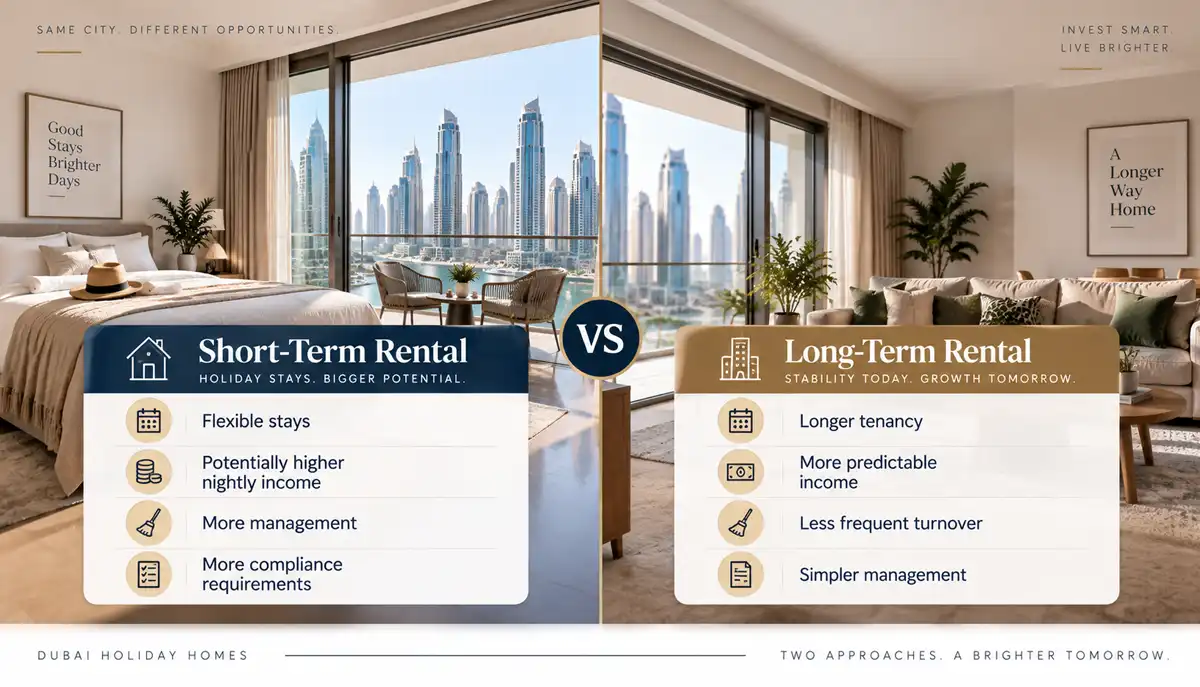
Short-term rental generates 30–65% higher gross income but incurs significantly higher operating expenses, management fees (20% vs 7%), cleaning, utilities, Tourism Dirham, furnishing depreciation, and platform commissions. In premium tourist areas like Dubai Marina and Downtown, the net advantage is clear. In secondary communities, long-term leasing often delivers comparable or better net returns with minimal management effort.
Operating Expenses: The True Financial Picture of Short-Term Rentals
Surprisingly, many investors focus exclusively on nightly rates without understanding the full expense structure. Here is every recurring obligation a short-term rental operator in Dubai faces.
Monthly Obligations
- Tourism Dirham — AED 10 (Standard) or AED 15 (Deluxe) per occupied bedroom per night. For a 1-bedroom at 75% occupancy, this amounts to approximately AED 2,740–4,100 per year
- 10% Municipality fee — levied on all booking revenue and remitted to Dubai Municipality. On AED 140,000 annual revenue, this adds AED 14,000
- Platform commission — Airbnb charges hosts 3% of the booking total. Booking.com charges 15–18%. Vrbo varies. For an Airbnb-primary property, budget 3% of gross revenue
- Cleaning between guests — AED 150–300 per turnover depending on unit size. At 100 turnovers per year, this totals AED 15,000–30,000
- Linen and laundry — AED 50–100 per turnover for fresh bed linen, towels, and bathrobes. Annual total: AED 5,000–10,000
- Utilities (DEWA) — unlike long-term leasing where the resident pays, short-term rental owners cover DEWA charges. Budget AED 500–800 per month (AED 6,000–9,600 per year)
- WiFi and streaming subscriptions — AED 300–500 per month for high-speed internet and entertainment packages guests expect
Annual Obligations
- Service charges — the same annual charge every property owner pays, regardless of rental strategy. Detailed in Divine LiWing’s dedicated service charges guide
- Holiday home management company fee — 15–25% of gross revenue for full-service management including guest communication, check-in coordination, cleaning oversight, and platform listing management
- Furnishing depreciation and replacement — holiday home furniture and appliances experience significantly more wear than long-term leased properties. Budget AED 5,000–10,000 per year for replacements, repairs, and periodic refreshes
- Property insurance — comprehensive coverage including guest liability is mandatory for the DET permit. Annual premiums typically range from AED 1,500–3,000
- VAT (if applicable) — 5% on all rental income once annual taxable turnover exceeds AED 375,000. For a single high-performing property, this threshold may not apply, but operators managing multiple units are likely to cross it
Building Restrictions: Not Every Dubai Property Can Be a Holiday Home
Crucially, before acquiring a property specifically for short-term rental, investors must verify that the building permits holiday home operations. Many owners’ associations in Dubai have explicitly prohibited short-term rentals through their community rules.
How to Check Before Ownership
Specifically, the building’s NOC (No Objection Certificate) is a mandatory requirement for the DET permit application. Without the NOC, DET will reject the application regardless of how well the property meets other requirements. Therefore, confirming NOC availability before completing any ownership transaction is essential.
In practice, contact the building management company directly and ask: “Does the owners’ association permit DET holiday home operations in this building?” Request written confirmation like verbal assurances are insufficient for the DET application process.
Buildings That Commonly Restrict Holiday Homes
Certain developers and communities have implemented blanket or partial restrictions on short-term rentals:
- Some Emaar towers — select Emaar buildings in Downtown Dubai and Dubai Marina have owners’ association rules restricting or prohibiting holiday homes. Each building has its own policy, check the specific tower
- Gated villa communities — some villa communities restrict short-term guests due to security and noise concerns from existing long-term residents
- DIFC residential towers — the DIFC’s own regulatory framework may impose additional restrictions beyond DET requirements
Conversely, many purpose-built holiday home-friendly buildings have emerged in recent years, particularly in Dubai Marina, JBR, and Business Bay. These buildings not only permit short-term rental but actively facilitate it with dedicated guest reception, luggage storage, and streamlined NOC processes. Working with an experienced broker who knows which buildings are holiday-home-friendly saves significant time and prevents costly ownership mistakes. Divine LiWing’s advisory team maintains a building-by-building database of NOC availability across all major communities.
Considering a short-term rental investment in Dubai? Contact Divine LiWing for expert guidance on building selection, DET permit support, and realistic yield projections based on actual market data.
Self-Management vs Holiday Home Management Companies
Inevitably, every short-term rental investor must decide whether to manage operations personally or delegate to a professional holiday home management company. This decision directly impacts both net income and personal time commitment.
Self-Management: Maximum Returns, Maximum Effort
In essence, self-managing owners handle guest communication, check-in/check-out coordination, cleaning scheduling, maintenance requests, listing optimisation, and pricing adjustments personally. By eliminating the 15–25% management fee, net returns improve dramatically. However, the time commitment is substantial, successful self-managers typically allocate 10–15 hours per week to operations, particularly during high-turnover peak seasons.
Consequently, self-management works best for Dubai-resident owners with a single property and the flexibility to respond to guest needs promptly. Additionally, self-managing owners must handle DET compliance themselves, guest registration within 3 hours, monthly Tourism Dirham submissions, and annual permit renewal.
Professional Management: Hands-Off, Higher Expenses
Alternatively, holiday home management companies such as GuestReady, Frank Porter, bnbme, Deluxe Holiday Homes, and Driven Holiday Homes offer end-to-end operations for property owners. Services typically include guest communication, check-in logistics, cleaning coordination, maintenance, linen supply, platform listing management, and dynamic pricing.
Typically, fees range from 15% to 25% of gross revenue depending on the service level and portfolio size. Some companies also charge onboarding fees (AED 2,000–5,000) for initial setup, photography, and listing creation. Despite the higher expense, professional management is essential for overseas investors and owners with multiple properties who cannot personally oversee daily operations.
Tax Obligations for Short-Term Rental Operators in Dubai
While Dubai’s zero income tax environment is one of the primary benefits of buying property in Dubai, short-term rental operators face specific tax obligations that differ from standard property ownership.
Tourism Dirham
Every holiday home operator must collect the Tourism Dirham from guests and remit it to DET monthly. The rate depends on the property classification: AED 10 per occupied bedroom per night for Standard properties and AED 15 per bedroom per night for Deluxe properties. This fee is collected from guests in addition to the nightly rate and is not the operator’s own expense; but failure to collect and remit it constitutes a compliance violation.
VAT (5%)
Furthermore, UAE VAT applies at 5% on short-term rental income once the operator’s taxable turnover exceeds AED 375,000 in any 12-month period. For a single property generating AED 180,000 annually, this threshold is unlikely to be reached. However, operators managing multiple properties will cross it quickly. Voluntary VAT registration is available from AED 187,500 turnover.
Corporate Tax (9%)
Since June 2023, UAE corporate tax applies at 9% on net profits exceeding AED 375,000 annually. For high-volume operators, this adds a meaningful expense layer. Importantly, the tax applies to net profit after all deductible expenses (service charges, management fees, maintenance, depreciation); not gross revenue. Consequently, many single-property operators remain below the effective threshold even if gross revenue is significant.
Furnishing a Holiday Home for Maximum Income
Undeniably, the quality of furnishing directly impacts nightly rates, guest reviews, and occupancy levels. Investing in the right furnishing strategy from the start prevents costly mistakes and maximises return potential.
What Guests Expect in 2026
Undoubtedly, guest expectations have evolved significantly. Beyond basic furniture, today’s holiday home guests expect:
- High-speed WiFi — minimum 100 Mbps, tested and verified. Slow WiFi is the number-one complaint in Dubai Airbnb reviews
- Smart TV with streaming — Netflix, Amazon Prime, or YouTube Premium access. Many guests treat the property as their evening entertainment base
- Quality mattress and linen — hotel-standard bedding is non-negotiable for achieving 4.8+ star ratings
- Fully equipped kitchen — coffee machine, induction cooktop or gas stove, microwave, dishwasher, and basic pantry staples
- Blackout curtains — essential in Dubai’s climate, particularly for bedrooms
- Iron, ironing board, and hair dryer — standard amenities that guests expect without asking
- Keyless entry — smart locks enabling self-check-in are increasingly expected, particularly for late-night arrivals
For investors exploring the premium segment, luxury properties in Dubai command significantly higher nightly rates when furnished to hotel-suite standards, designer furniture, premium appliances, and curated artwork.
Holiday Home Furnishing Budget: What to Invest and Where to Save
Furnishing a holiday home requires a different approach than furnishing a personal residence or a long-term rental. Because short-term guests expect hotel-quality presentation while the property endures significantly higher wear, the furnishing strategy must balance quality, durability, and visual appeal.
Recommended Furnishing Budget by Unit Type
| Unit Type | Basic Furnishing | Mid-Range (Recommended) | Premium |
|---|---|---|---|
| Studio | AED 15,000–20,000 | AED 25,000–35,000 | AED 45,000+ |
| 1-Bedroom | AED 25,000–35,000 | AED 40,000–55,000 | AED 70,000+ |
| 2-Bedroom | AED 40,000–55,000 | AED 60,000–80,000 | AED 100,000+ |
| 3-Bedroom Villa | AED 70,000–90,000 | AED 100,000–140,000 | AED 180,000+ |
Where to Invest: Items That Impact Guest Reviews Most
Specifically, guest reviews on Airbnb and Booking.com consistently highlight three areas as the primary drivers of satisfaction or complaint:
- Mattress and bedding — a high-quality mattress (AED 2,000–4,000) and hotel-grade linen set (AED 500–1,000) are the single most impactful investment. More than any other item, sleep quality determines the overall guest experience and review rating
- Bathroom essentials — quality towels (replaced every 6–9 months), premium toiletries (full-size bottles, not sachets), and a properly functioning shower with good water pressure. Bathroom complaints are the second most common source of negative reviews
- Kitchen functionality — guests expect a working coffee machine, clean cookware, sharp knives, and basic condiments. An under-equipped kitchen generates frustration disproportionate to the small investment required to resolve it
Where to Save: Items Guests Rarely Notice
Conversely, several furnishing categories can be sourced economically without impacting guest satisfaction:
- Living room furniture — mid-range sofas and coffee tables from IKEA, Home Centre, or Pan Emirates deliver adequate quality at 30–50% of premium pricing. Guests sit on the sofa; they do not inspect the brand label
- Decorative items — affordable prints, cushions, and artificial plants from local home stores create visual warmth without premium expense. Replace seasonally to keep the listing photography fresh
- Dining furniture — functional dining sets in the AED 1,000–2,000 range serve guest needs adequately. Most short-stay guests eat out more than they cook
Moreover, sourcing furniture from suppliers who offer bulk or package deals (such as Danube Home, IKEA Business, or specialised holiday home furnishing companies) can reduce the total budget by 15–20% compared to purchasing items individually.
Combining Short-Term Rental with Golden Visa Strategy
For investors who hold or are targeting a Dubai Golden Visa through property ownership, the short-term rental strategy adds an income acceleration layer on top of the residency benefit. Because the Golden Visa permits extended absences from the UAE, investors can live abroad for much of the year while their Dubai property generates premium holiday home income.
How the Dual Strategy Works
Consider an investor who owns an AED 2.5 million apartment in Dubai Marina, qualifying for the 10-year Golden Visa. Rather than leasing the property on a standard annual contract (generating approximately AED 110,000/year), the investor operates it as a holiday home during 10 months of the year and blocks 2 months for personal use during peak winter season.
Consequently, the 10 months of holiday home operation generate approximately AED 145,000 in gross income (higher per-night rates but fewer total nights), while the investor personally enjoys the property during Dubai’s most pleasant weather. After operating expenses, net income approximates AED 65,000–75,000 comparable to the long-term lease net; but with the added benefit of 2 months of personal accommodation in Dubai valued at approximately AED 20,000 in equivalent hotel spending.
Essentially, the property simultaneously serves three functions: a Golden Visa qualification asset, an income-generating investment, and a personal holiday residence. For a complete guide on the Golden Visa property route, explore how to invest in Dubai real estate with confidence.
Working With Divine LiWing: Short-Term Rental Investment Advisory
As a Business Bay-based luxury real estate consultancy, Divine LiWing helps investors identify the right properties for short-term rental operations from building-level NOC verification and DET permit support to realistic yield projections based on actual occupancy and rate data.
Specifically, the Divine LiWing advisory team evaluates every short-term rental opportunity across five dimensions: building NOC availability, DET permit eligibility, community-level occupancy data, competitive nightly rate analysis, and total expense modelling. Furthermore, for investors weighing the short term vs long term rental yield dubai comparison, Divine LiWing provides side-by-side net income projections for both strategies tailored to the specific property under consideration.
Whether you are acquiring your first investment property or converting an existing holding to a holiday home, contact Divine LiWing today for a personalised consultation grounded in real market data; not marketing projections. Combined with the structural benefits of buying property in Dubai like zero tax, strong appreciation, and long-term residency pathways, holiday home operations can significantly enhance overall portfolio returns.
Real-World Case Study: Short-Term Rental in Dubai Marina
To illustrate how short term rental dubai rules translate into actual returns, consider the following scenario based on a composite of real client experiences at Divine LiWing.
The Property
A fully furnished 1-bedroom apartment in Dubai Marina, 750 sqft, with partial sea views. The property was acquired for AED 1.6 million. After DLD transfer fees, agent fees, and furnishing, the total investment stood at approximately AED 1,780,000.
The Setup Process
Initially, the investor confirmed building NOC availability before ownership completion, the tower permits holiday home operations without restriction. Subsequently, after receiving the title deed, the investor applied for the DET holiday home permit (AED 1,520), completed the property classification (Deluxe), and listed on Airbnb, Booking.com, and a local holiday home aggregator.
Additionally, the investor appointed a local holiday home management company at 18% of gross revenue, covering guest communication, check-in coordination, cleaning, linen supply, and DET compliance including guest registration and Tourism Dirham submissions.
Year One Results
| Metric | Amount |
|---|---|
| Total nights occupied | 267 (73% occupancy) |
| Average nightly rate | AED 620 |
| Gross annual income | AED 165,540 |
| Management fee (18%) | -AED 29,797 |
| Service charges | -AED 14,250 |
| Chiller charges | -AED 5,400 |
| DEWA utilities | -AED 7,200 |
| Tourism Dirham | -AED 4,005 |
| Cleaning (85 turnovers × AED 200) | -AED 17,000 |
| Linen and supplies | -AED 6,800 |
| Platform commissions (3%) | -AED 4,966 |
| Insurance | -AED 2,200 |
| WiFi and streaming | -AED 4,800 |
| Furnishing replacement reserve | -AED 6,000 |
| Net annual income | AED 63,122 |
| Net yield on total investment | 3.5% |
Long-Term Lease Comparison for the Same Property
For context, the same apartment would generate approximately AED 90,000 per year on a long-term lease. After deducting service charges (AED 14,250), property management at 7% (AED 6,300), and vacancy provision (AED 3,462), the net income would be approximately AED 65,988 a net yield of 3.7%.
Key takeaway: In this Dubai Marina example, the short-term rental generated nearly identical net income (AED 63,122) to the long-term lease (AED 65,988) after the significantly higher operating expenses were deducted. However, the short-term strategy preserves flexibility, the investor can use the property personally during any blocked period and adjust strategy year-to-year. Subsequently, in year two, after optimising pricing and reducing management costs, the investor’s net yield improved to 4.3%.
Guest Experience Optimisation: Maximising Reviews and Occupancy
Because Airbnb and Booking.com algorithms heavily favour properties with high review scores, optimising the guest experience directly impacts both occupancy rates and achievable nightly rates. Properties rated 4.8 stars or above consistently appear higher in search results and convert viewers to bookings at significantly higher rates.
The Five Pillars of Guest Satisfaction in Dubai
- Communication speed — respond to booking inquiries within 30 minutes. Airbnb’s algorithm penalises slow responders. If using a management company, confirm their average response time before appointment
- Seamless check-in — smart locks with digital codes eliminate the friction of key handovers and allow guests arriving on late-night flights to access the property immediately. Consequently, self-check-in is now expected by over 80% of Dubai Airbnb guests
- Impeccable cleanliness — hire professional cleaning teams, not casual cleaners. Provide hotel-standard fresh linens, towels, and bathroom amenities for every guest. One negative cleanliness review can reduce booking conversion rates by 15–20%
- Local guidebook — a printed or digital welcome guide covering nearby restaurants, attractions, transport options, emergency numbers, and WiFi details elevates the guest experience from functional to memorable. Furthermore, personalised recommendations specific to the neighbourhood generate positive review mentions
- Swift maintenance response — AC malfunctions, plumbing issues, or WiFi outages during a guest’s stay are inevitable. Having a maintenance contact who can respond within 2 hours prevents a minor inconvenience from becoming a negative review
Dynamic Pricing: The Revenue Multiplier
Professional operators use dynamic pricing tools such as PriceLabs, Beyond Pricing, and Wheelhouse to adjust nightly rates automatically based on real-time demand, competitor rates, local events, and seasonality. Essentially, these tools function like airline revenue management systems increasing rates during high-demand periods and reducing them during low-demand windows to maintain occupancy.
In practice, dynamic pricing increases annual revenue by 15–25% compared to static pricing without any change to the property itself. For a property generating AED 150,000 with static pricing, dynamic optimisation could add AED 22,500–37,500 in additional annual revenue. Because these tools typically charge AED 50–100 per month per property, the return on investment is substantial.
Legal Protections for Holiday Home Owners in Dubai
Dubai’s regulatory framework provides specific protections for holiday home operators alongside the compliance obligations already discussed. Understanding these protections helps operators manage risk effectively.
Guest Damage and Security Deposits
Operators can collect a security deposit from guests to cover potential damage. Airbnb provides its AirCover programme, which covers up to USD 3 million in property damage, while Booking.com offers a damage deposit collection feature. Nevertheless, comprehensive property insurance remains essential, platform protections have limitations and exclusions that may not cover all scenarios.
Dispute Resolution
Disputes between holiday home operators and guests can be escalated through the booking platform’s resolution centre. For more serious disputes such as property damage, unpaid charges, or guest behaviour issues; Dubai’s RERA and DET provide formal complaint mechanisms. Additionally, Dubai Police can be contacted for criminal matters such as theft or property destruction.
Regulatory Support
DET provides dedicated support channels for licensed holiday home operators. Because the regulatory framework is designed to professionalise the sector rather than restrict it, compliant operators generally find DET responsive and supportive. The DET Holiday Homes portal includes resources, FAQs, and direct contact options for permit holders.
Future Outlook: Short-Term Rental Market in Dubai (2026–2030)
Several structural factors suggest the Dubai short-term rental market will continue expanding through 2030, making it an increasingly attractive component of a diversified property portfolio.
Tourism Growth Trajectory
Dubai’s D33 economic strategy targets 25 million annual visitors by 2030. Simultaneously, the city is expanding its attraction portfolio, Museum of the Future, Ain Dubai, Dubai Creek Tower, and multiple Expo City developments create new reasons for repeat visitation. Consequently, holiday home demand is expected to grow 8–12% annually through the end of the decade.
Supply-Demand Dynamics
While new residential supply continues entering the market, not all buildings permit holiday home operations. Because many owners’ associations restrict short-term rentals, the effective supply of licensed holiday homes grows more slowly than total residential supply. In turn, this supply constraint supports occupancy rates and nightly pricing for compliant operators.
Regulatory Maturation
Furthermore, DET continues refining the regulatory framework toward greater professionalism and quality. Higher standards may increase compliance costs marginally but will also improve the overall reputation of Dubai’s holiday home sector ultimately benefiting professional operators through higher guest trust and willingness to pay premium rates.
For investors building a long-term Dubai property portfolio, the short-term rental strategy offers a compelling income layer when applied to the right properties in the right communities. Combined with the structural benefits of buying property in Dubai like zero tax, strong appreciation, and long-term residency pathways, holiday home operations can significantly enhance overall portfolio returns.
Short-Term Rental Insurance: What Coverage Do You Need?
Standard home insurance does not cover short-term rental activity. Therefore, holiday home operators must obtain specific coverage that protects against the unique risks of hosting paying guests.
Mandatory vs Recommended Coverage
DET requires valid property insurance as a condition of the holiday home permit. However, the minimum mandatory coverage may not protect against all scenarios operators face. Below is a breakdown of the coverage layers every serious operator should consider.
| Coverage Type | What It Covers | Mandatory? | Typical Annual Premium |
|---|---|---|---|
| Building Insurance | Structural damage (usually covered by service charges) | Yes (via service charge) | Included in service charge |
| Contents Insurance | Furniture, appliances, electronics, furnishings | Recommended | AED 1,000–3,000 |
| Public Liability | Guest injury on the property (slip, fall, burn) | Strongly recommended | AED 800–2,000 |
| Loss of Rental Income | Income lost during repair periods after covered damage | Optional | AED 500–1,500 |
| Guest Damage | Intentional or accidental damage by guests beyond normal wear | Recommended | AED 500–1,200 |
Consequently, a comprehensive holiday home insurance package typically costs AED 2,500–5,000 per year, a modest expense relative to the total income generated and the financial exposure of hosting dozens of different guests annually. Additionally, several UAE insurance companies now offer bundled “holiday home operator” policies that combine all coverage types into a single annual premium.
Compliance Calendar: Monthly and Annual Obligations
Running a compliant holiday home in Dubai requires adherence to a regular compliance calendar. Missing deadlines results in fines, permit suspension, or listing removal. Below is the complete calendar every operator should follow.
Real-Time Obligations
- Guest registration — register every guest in the DET system within 3 hours of check-in using valid passport or Emirates ID details. This is the most actively enforced requirement in 2026
- Permit number display — ensure the DET permit number appears on every active listing across all platforms at all times
Monthly Obligations
- Tourism Dirham submission — file and pay collected Tourism Dirham by the 15th of each month through the Holiday Homes portal. The Holiday Homes 2.0 system auto-generates payment orders on the 11th, giving operators 4 days to review and pay
- 10% Municipality fee — remit the Dubai Municipality fee on all booking revenue. Some management companies handle this on behalf of owners
- VAT filing (if registered) — file quarterly VAT returns if turnover exceeds AED 375,000. Returns are due within 28 days of the end of each quarter
Annual Obligations
- Permit renewal — renew within the 30-day window before expiry. Missing the window means the permit lapses entirely
- Trade licence update — update trade licence information annually if operating as a registered holiday home operator
- Insurance renewal — maintain continuous property insurance coverage without lapses
- Safety equipment inspection — verify fire extinguishers, smoke detectors, and first aid kits are functional and not expired
- Service charge payment — clear annual service charges to maintain good standing with the building management
Common Mistakes That Reduce Short-Term Rental Returns
After advising hundreds of property owners, Divine LiWing has identified the most common errors that reduce holiday home profitability. Avoiding these mistakes from the start protects both income and reputation.
Mistake 1: Choosing the Wrong Building
Arguably the most costly error is acquiring a property in a building that prohibits holiday homes, only discovering this after completing the ownership transfer. Because the building NOC is mandatory for the DET permit, owning in a restricted building forces the investor into long-term leasing whether they intended to or not. Always verify NOC availability before signing the SPA.
Mistake 2: Underestimating Operating Expenses
Many first-time operators compare their gross short-term rental income to gross long-term lease income and conclude the short-term route is dramatically more profitable. However, once management fees (15–25%), cleaning, utilities, Tourism Dirham, platform commissions, and furnishing depreciation are deducted, the net advantage is often much narrower than expected and sometimes negative in non-premium locations.
Mistake 3: Static Pricing Year-Round
Setting a single nightly rate and leaving it unchanged throughout the year leaves significant revenue on the table. During peak season (October–April), rates should be 30–50% higher than shoulder season. During summer, rates should be reduced to maintain occupancy rather than sitting empty at premium rates. Dynamic pricing tools solve this automatically and typically pay for themselves within the first month.
Mistake 4: Neglecting Reviews and Guest Communication
On Airbnb and Booking.com, properties rated below 4.5 stars experience a measurable drop in booking conversion and search visibility. Even one or two negative reviews about cleanliness, communication delays, or inaccurate listing descriptions can suppress bookings for weeks. Consequently, investing in professional cleaning, rapid communication (sub-30-minute responses), and accurate listing photography is not optional; it is essential for maintaining competitive positioning.
Mistake 5: Ignoring Seasonality in Acquisition Timing
Investors who complete their property ownership and DET permit setup in April or May face an immediate low season, generating limited income during their first 4–5 months. By contrast, completing the setup in August or September positions the property to launch into peak season immediately, building reviews and momentum when demand is highest. While this does not change the long-term returns, it significantly improves the first-year financial experience and reduces early discouragement.
Ready to maximise your Dubai property income through short-term rental? Speak with Divine LiWing’s advisory team for building-level NOC verification, DET permit guidance, and data-driven yield projections tailored to your property.
Frequently Asked Questions
Every property offered for stays under six months in Dubai must hold a valid DET holiday home permit. Operators must collect Tourism Dirham per bedroom per night (AED 10 Standard / AED 15 Deluxe), register guests within 3 hours, maintain safety equipment, and display the permit number on all listings. Operating without a permit carries fines from AED 5,000 to AED 100,000.
A 1-bedroom apartment in Dubai Marina generates approximately AED 150,000–225,000 in gross annual income on Airbnb, while Business Bay yields AED 102,000–171,000. Net income after management fees, cleaning, utilities, Tourism Dirham, and platform commissions typically runs 40–55% of gross. Results depend heavily on location, furnishing quality, and pricing strategy.
Yes. A No Objection Certificate from the building’s management company or owners’ association is a mandatory requirement for the DET permit application. Some buildings prohibit short-term rentals entirely. Always confirm NOC availability before completing any property ownership transaction intended for holiday home use.
The Tourism Dirham is a nightly per-bedroom fee collected from guests by the holiday home operator and remitted to DET by the 15th of each month. The rate is AED 10 per bedroom per night for Standard-classified properties and AED 15 for Deluxe properties. Failure to collect and remit this fee can result in fines and permit suspension.
In premium tourist areas (Dubai Marina, Downtown, JBR, Palm Jumeirah), short-term rental typically delivers 20–40% higher net returns than long-term leasing. In secondary communities (JVC, Dubai Silicon Oasis), the higher operating expenses of short-term rental often result in comparable or lower net returns than a simple annual lease. The decision depends on location, owner involvement, and building NOC availability.
Yes, but you will need to appoint a professional holiday home management company to handle day-to-day operations, guest check-in, cleaning, and DET compliance. Management companies charge 15–25% of gross revenue. The DET permit application itself requires either personal attendance or a valid Power of Attorney for an authorised representative in Dubai.
Operating without a DET holiday home permit carries fines starting at AED 5,000, with repeat offences escalating to AED 100,000 within 12 months. Additionally, Airbnb and other platforms are legally required to verify permit numbers and will delist non-compliant properties. The listing may also be flagged by DET enforcement, resulting in further administrative action.
Pingback:Dubai Investment 2026 | 5 Reasons to Buy Property Now