The Complete Mortgage Guide for Owning Property in Dubai as a Foreigner
Securing a mortgage for property in dubai as a foreigner is not only possible, it is increasingly common, with mortgage-backed transactions growing 30% year-on-year in early 2026 as international investors leverage UAE banking products to enter one of the world’s most dynamic property markets. Whether you are a UAE-based expat or a non-resident investor living abroad, several major banks actively offer competitive financing products designed specifically for foreign property ownership.
However, the terms, eligibility requirements, and strategic considerations differ significantly between resident and non-resident applicants. Furthermore, non-resident mortgage dubai banks impose stricter loan-to-value (LTV) ratios, require larger initial amounts, and offer fewer product options compared to UAE-resident borrowers. Understanding these differences before starting the application process saves weeks of effort and prevents costly misalignment between financing expectations and banking reality.
Additionally, this guide from Divine LiWing covers every dimension of property financing in Dubai from mortgage interest rates dubai 2026, to eligibility criteria for expats and non-residents, the best banks for property mortgage dubai, a detailed comparison of mortgage vs cash ownership strategies, and the step-by-step application process. For the broader investment case, this article complements our comprehensive guide to the benefits of buying property in Dubai.
Can Foreigners Get a Mortgage in Dubai?
Yes and the process is more structured and accessible than most overseas investors expect. UAE banks actively lend to foreign nationals for freehold property ownership in designated areas across Dubai. Specifically, both UAE-resident expats and non-resident international investors can access mortgage financing, though the terms differ between these two categories.
Importantly, mortgage financing is available only for properties located in DLD-designated freehold zones, areas where foreign nationals are permitted to own property outright. Leasehold properties and units in non-freehold areas do not qualify for mortgage financing to foreign borrowers. For a complete understanding of where foreigners can own, read Divine LiWing’s guide on whether foreigners can own property in Dubai.
Resident Expat vs Non-Resident: How the Terms Differ
| Factor | UAE Resident Expat | Non-Resident (Living Abroad) |
|---|---|---|
| Maximum LTV (first property under AED 5M) | 80% (20% initial amount) | 50–65% (35–50% initial amount) |
| Maximum LTV (property over AED 5M) | 70% | 50–60% |
| Interest Rates (2026) | 3.99–5.5% | 4.5–6.5% |
| Maximum Tenure | 25 years | 20–25 years |
| Minimum Income Required | AED 15,000/month | AED 15,000/month (or equivalent) |
| Bank Options | All major UAE banks | Select banks (HSBC, Emirates NBD, Mashreq, ADIB, RAK Bank) |
| Age Limit | 21–65 (salaried) / 70 (self-employed) | 21–65 (salaried) / 70 (self-employed) |
Consequently, the most significant difference is the initial amount requirement. A non-resident acquiring an AED 2 million apartment needs AED 700,000–1,000,000 upfront, compared to AED 400,000 for a UAE resident. Despite this higher barrier, the leverage still allows non-residents to control a substantial asset while preserving capital for diversification.
Can a non-resident get a mortgage in Dubai without living in the UAE?
Yes. Several major UAE banks including HSBC, Emirates NBD, Mashreq, and ADIB actively offer mortgage products to non-residents living abroad. Non-residents typically receive 50–65% loan-to-value ratios, requiring a 35–50% initial amount. The property must be in a DLD-designated freehold zone, and the applicant must meet minimum income and documentation requirements.
Mortgage Eligibility for Expats in Dubai: Full Requirements
Understanding the complete mortgage eligibility for expats dubai banks evaluate ensures a smooth application with minimal delays. Banks assess applicants across several dimensions before approving a mortgage for property in dubai.

Core Eligibility Criteria
- Age — minimum 21 years, maximum 65 years for salaried applicants and 70 years for self-employed. The mortgage must be fully repaid by the age limit, which may shorten the available tenure for older applicants
- Minimum income — most banks require a minimum monthly income of AED 15,000 (approximately USD 4,100 / GBP 3,300 / EUR 3,800). Some banks accept lower thresholds for specific products or relationship banking clients
- Debt-to-income ratio (DTI) — UAE Central Bank regulations cap total monthly obligations (including the proposed mortgage) at 50% of monthly income. Existing car financing, personal loans, and credit card minimum obligations all count toward this cap
- Credit history — banks review the applicant’s credit report from their country of residence. For UAE residents, the Al Etihad Credit Bureau (AECB) report is mandatory. Clean credit history with no defaults significantly improves approval rates and may secure better interest rates
- Employment stability — banks prefer applicants with at least 2 years of continuous employment or 2 years of business operation (for self-employed). Frequent job changes or employment gaps raise risk flags
- Nationality — most nationalities are accepted by major UAE banks. UK, EU, US, Canadian, Australian, and Indian nationals have the widest choice of lenders. Some banks maintain restricted nationality lists — always confirm before applying
Required Documents for Mortgage Application
- Valid passport with minimum 6 months remaining validity
- Emirates ID (for UAE residents) or proof of overseas residence
- Salary certificate or employment contract from current employer
- Six months of bank statements showing salary credits
- Credit report from country of residence (AECB report for UAE residents)
- Proof of initial amount funds (bank statement showing available capital)
- Property details — sales agreement, title deed or Oqood, and developer confirmation
- For self-employed: audited financial statements (2 years), trade licence, and company bank statements
Submitting a complete application with all documents prepared in advance significantly reduces processing time. Incomplete applications are the primary cause of delays, with banks returning files for missing documentation rather than progressing them.
Mortgage Interest Rates Dubai 2026: Current Market Overview
Understanding mortgage interest rates dubai 2026 is essential for calculating true ownership expenses and comparing financing options. UAE mortgage rates are influenced by the Emirates Interbank Offered Rate (EIBOR), which tracks closely with US Federal Reserve rate movements due to the dirham’s dollar peg.
Current Rate Ranges (2026)
| Rate Type | UAE Residents | Non-Residents | How It Works |
|---|---|---|---|
| Fixed Rate (1–5 years) | 3.99–5.0% | 4.5–5.5% | Locked rate for the fixed period, then converts to variable |
| Variable Rate | EIBOR + 1.5–2.5% | EIBOR + 2.0–3.0% | Rate adjusts quarterly based on EIBOR movements |
| Hybrid (Fixed then Variable) | 4.0–4.5% fixed (3 yrs), then variable | 4.5–5.5% fixed (3 yrs), then variable | Combines stability and flexibility |
Fixed vs Variable: Which Should You Choose?
Fixed-rate mortgages provide predictable monthly contributions for the fixed period (typically 1, 3, or 5 years), making budgeting straightforward. However, after the fixed period expires, the rate converts to a variable rate, often at a higher spread. Consequently, many investors take a 3-year fixed rate and then refinance to a new fixed-rate product before the variable period begins.
Conversely, variable-rate mortgages track EIBOR plus a bank-specific margin. When EIBOR is low, variable rates can be significantly cheaper than fixed rates. Nevertheless, if EIBOR rises, monthly contributions increase accordingly. Because the UAE dirham is pegged to the US dollar, EIBOR tends to follow US Federal Reserve rate movements, meaning rate expectations should align with US monetary policy outlook.
What are the current mortgage interest rates in Dubai for 2026?
In 2026, fixed mortgage rates in Dubai range from 3.99–5.0% for UAE residents and 4.5–5.5% for non-residents. Variable rates are EIBOR plus 1.5–3.0% depending on residency status. Most banks offer hybrid products with a fixed period (1–5 years) that converts to variable. Rates are influenced by EIBOR, which tracks US Federal Reserve movements due to the dirham’s dollar peg.
Best Banks for Property Mortgage in Dubai: Comparison
Not all UAE banks offer mortgages to foreign nationals, and among those that do, product features vary significantly. Below is a comparison of the best banks for property mortgage dubai investors should evaluate in 2026.
| Bank | Non-Resident? | Max LTV (Non-Res) | Fixed Rate From | Min. Property Value | Notable Features |
|---|---|---|---|---|---|
| HSBC UAE | Yes | 60% | 4.09% | AED 500,000 | Strong for UK/EU applicants; Premier relationship benefits |
| Emirates NBD | Yes | 60% | 4.25% | AED 500,000 | UAE’s second-largest bank; wide product range |
| Mashreq Bank | Yes | 65% | 4.49% | AED 500,000 | Higher LTV for non-residents; competitive rates |
| ADIB (Abu Dhabi Islamic Bank) | Yes | 60% | 4.39% | AED 500,000 | Sharia-compliant financing (Ijara structure) |
| RAK Bank | Yes | 60% | 4.49% | AED 500,000 | Flexible for self-employed applicants |
| Dubai Islamic Bank | Limited | 50% | 4.5% | AED 500,000 | Sharia-compliant; primarily for residents |
| FAB (First Abu Dhabi Bank) | Residents only | N/A | 3.99% | AED 500,000 | Best rates for UAE residents |
Notably, Mashreq Bank offers the highest LTV for non-residents at 65%, meaning a 35% initial amount compared to the standard 40–50% at most other banks. For investors with strong income documentation and credit history, Mashreq may provide the most capital-efficient financing structure.
Furthermore, HSBC UAE offers preferential terms for existing HSBC Premier or Advance relationship holders in other countries. A UK-based HSBC Premier client applying for a Dubai mortgage through HSBC UAE can benefit from streamlined documentation, faster processing, and potentially better rates. For a detailed breakdown of investment strategies, explore Divine LiWing’s proven approaches.
Mortgage vs Cash: Which Strategy Is Better for Dubai Property?
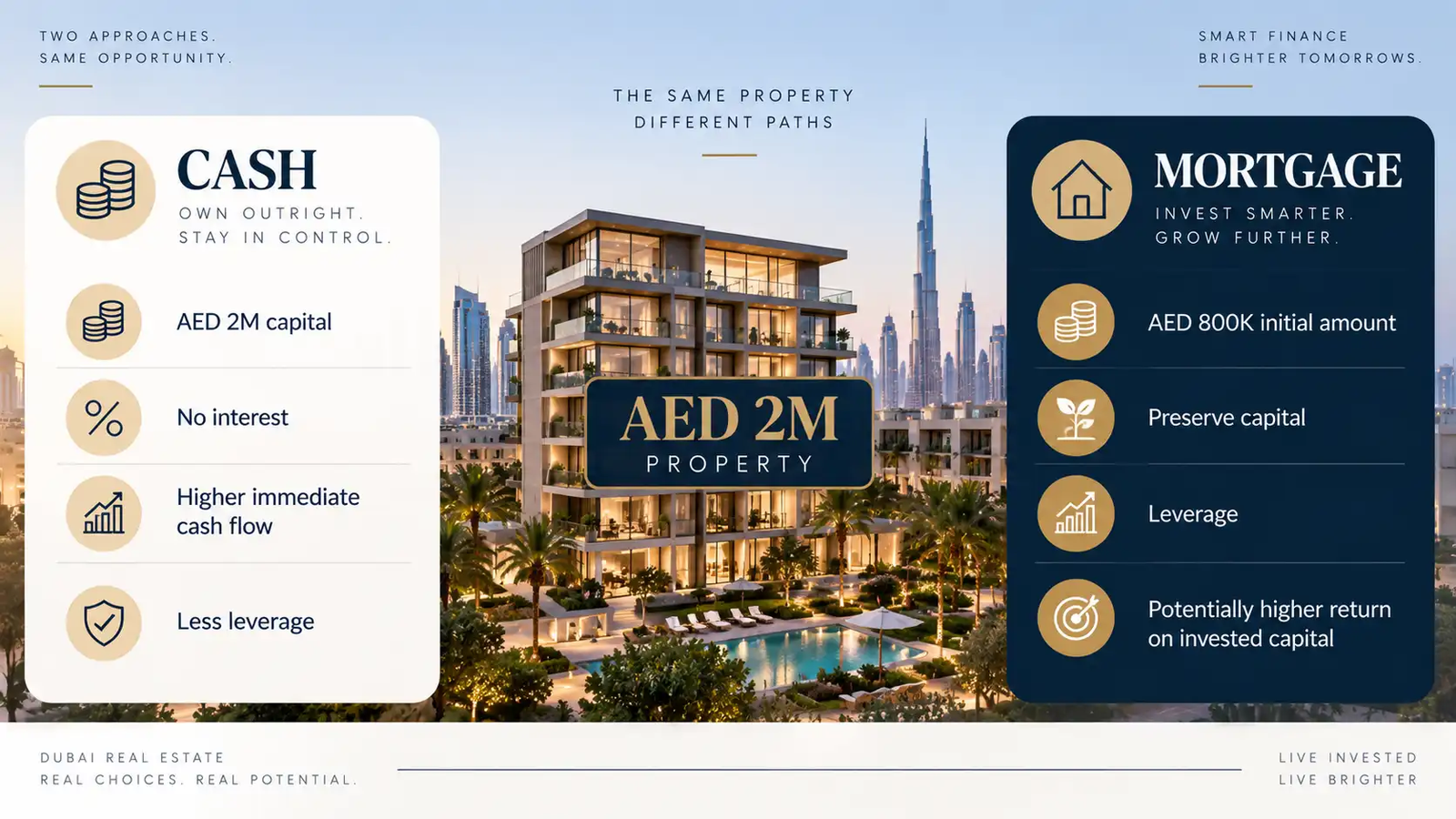
One of the most debated questions among Dubai property investors is the mortgage vs cash buying property dubai comparison. Both strategies have distinct advantages, and the optimal choice depends on the investor’s financial position, risk tolerance, and portfolio objectives.
The Case for Cash Ownership
- No interest expense — the entire rental income flows to the investor without mortgage repayment deductions, maximising immediate cash flow
- Faster transaction — cash acquisitions close within 1–2 weeks compared to 4–8 weeks for mortgaged transactions
- Stronger negotiation position — sellers and developers often prefer cash acquirers, sometimes offering 2–5% reductions for immediate settlement
- No bank qualification required — eliminates the documentation, income verification, and credit check process entirely
- Lower total ownership expense — no interest, no mortgage registration fee (0.25% of loan + AED 290), and no bank valuation fee (AED 2,500–3,500)
The Case for Mortgage Financing
- Capital preservation — instead of committing AED 2 million to a single property, an investor can put AED 400,000–800,000 as the initial amount and deploy the remaining capital elsewhere
- Leverage amplifies returns — if a property appreciates 10% (AED 200,000 gain on AED 2M), a cash investor earned 10% return. An investor who put AED 400,000 as an initial amount earned 50% return on invested capital from the same AED 200,000 appreciation
- Portfolio diversification — financing one property frees capital to invest in multiple assets (additional properties, equities, bonds), reducing concentration risk
- Tax-free rental income covers financing — because Dubai rental income is tax-free, gross rental yields of 6–8% often exceed or match the mortgage interest rate, making the property self-financing
- Golden Visa qualification — since February 2026, mortgaged properties qualify for the 10-year Golden Visa at full registered value. Read the complete guide in Divine LiWing’s Golden Visa property investment article
Side-by-Side Financial Comparison
| Metric | Cash Ownership (AED 2M property) | Mortgaged (60% LTV, AED 2M property) |
|---|---|---|
| Capital Deployed | AED 2,000,000 | AED 800,000 (40% initial amount) |
| Annual Rental Income | AED 140,000 | AED 140,000 |
| Annual Mortgage Repayment | AED 0 | -AED 96,000 (approx. at 5%, 20 yrs) |
| Service Charges + Expenses | -AED 25,000 | -AED 25,000 |
| Net Annual Income | AED 115,000 | AED 19,000 |
| Cash-on-Cash Return | 5.75% | 2.38% |
| 5-Year Appreciation (estimated 25%) | AED 500,000 | AED 500,000 |
| Total 5-Year Return on Capital Deployed | 53.75% | 74.75% |
Key insight: Cash ownership delivers higher annual cash flow (AED 115,000 vs AED 19,000), but mortgage financing generates a higher total return on invested capital (74.75% vs 53.75% over 5 years) due to leverage amplifying the capital appreciation. Essentially, the mortgage strategy sacrifices current income for higher total returns making it better suited for growth-oriented investors, while cash ownership suits income-focused investors.
Is it better to pay cash or get a mortgage for Dubai property?
Cash ownership maximises immediate rental income and simplifies the transaction process. Mortgage financing preserves capital for diversification and amplifies total returns through leverage particularly powerful in a market with strong appreciation trends. The right choice depends on the investor’s priority: income-focused investors benefit from cash, while growth-oriented investors benefit from financing. In Dubai’s zero-tax environment, both strategies outperform equivalent investments in most other global cities.
Need expert guidance on structuring your Dubai property financing? Contact Divine LiWing, our Business Bay team connects investors with the right banking products and walks you through the entire mortgage process.
Step-by-Step: How to Get a Mortgage for Property in Dubai
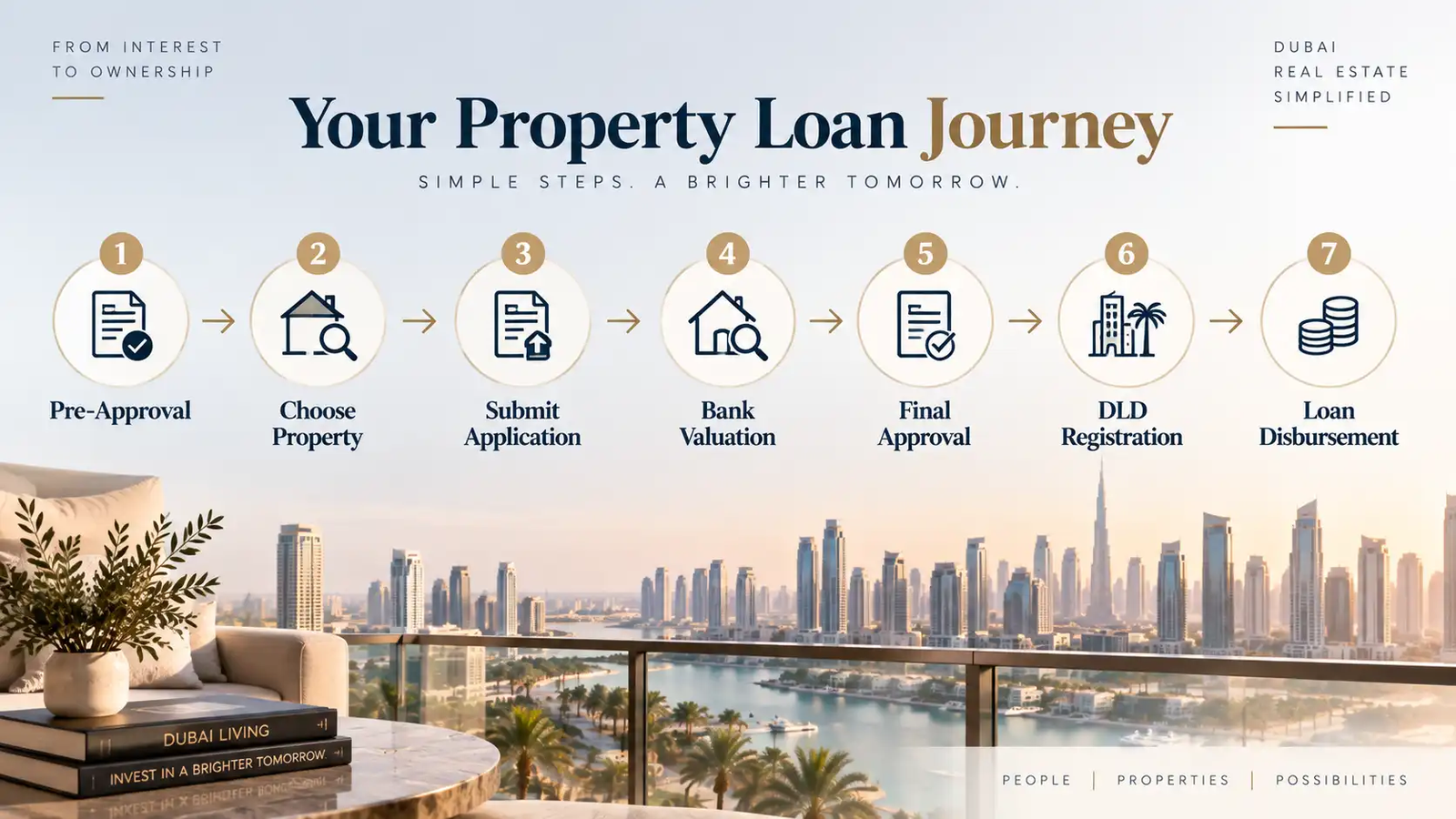
Once eligibility is confirmed and documents are prepared, the mortgage for property in dubai application follows a structured sequence. The typical timeline from application to disbursement is 4–8 weeks for non-residents and 2–4 weeks for UAE residents.
- Get pre-approved — submit your financial documents to the bank before selecting a property. Pre-approval confirms your borrowing capacity and strengthens your negotiation position. Most pre-approvals are valid for 60–90 days
- Select your property — with pre-approval in hand, identify a qualifying freehold property within your approved budget. Sign a Memorandum of Understanding (MOU) with the seller and pay the standard 10% deposit
- Formal mortgage application — submit the complete application with all required documents, property details, and the signed MOU to the bank
- Bank valuation — the bank commissions an independent property valuation (typically AED 2,500–3,500, paid by the applicant). The valuation confirms the property’s market value and ensures it meets the bank’s lending criteria
- Final approval and offer letter — once the valuation is satisfactory, the bank issues a formal mortgage offer letter detailing the loan amount, interest rate, tenure, and monthly contribution. Review all terms carefully before signing
- Mortgage registration — both parties attend the DLD to complete the property transfer. The mortgage is registered simultaneously, with the DLD charging 0.25% of the loan amount plus AED 290 as the mortgage registration fee
- Disbursement — the bank disburses the loan amount directly to the seller. The investor pays the initial amount, DLD transfer fee (4%), agent professional fee, and associated charges
For non-residents, the process may involve additional steps including courier delivery of original documents, notarised copies, and potentially a Power of Attorney for the DLD transfer. Working with an experienced broker streamlines this process significantly.
Total Acquisition Expenses When Financing a Dubai Property
Beyond the initial amount, investors financing a mortgage for property in dubai must budget for several additional fees that apply specifically to mortgaged transactions.
| Fee Category | Amount | When Payable |
|---|---|---|
| DLD Transfer Fee | 4% of property value | At transfer |
| Agent Professional Fee | 2% of property value | At transfer |
| DLD Admin Fee | AED 580 | At transfer |
| Mortgage Registration Fee | 0.25% of loan amount + AED 290 | At transfer |
| Bank Processing Fee | 1% of loan amount (some banks) | At approval |
| Property Valuation | AED 2,500–3,500 | During application |
| Life Insurance (bank requirement) | 0.4–0.7% of outstanding loan/year | Annually |
| Property Insurance | AED 1,000–3,000/year | Annually |
Altogether, investors should budget approximately 8–10% above the property value for total acquisition fees when using mortgage financing compared to 6–8% for cash transactions. The additional 2% covers the mortgage registration fee, bank processing fee, and valuation charge.
For a comprehensive view of recurring ownership fees beyond acquisition, read Divine LiWing’s guide on service charges in Dubai property.
Refinancing: When and Why to Switch Your Dubai Mortgage
Refinancing – replacing an existing mortgage with a new one from a different bank — is a common strategy among Dubai property owners. Because UAE banks compete actively for mortgage business, refinancing can reduce interest rates, lower monthly contributions, or release equity for additional investments.
When Refinancing Makes Sense
- Fixed period expiring — when a fixed-rate period ends and the rate converts to a higher variable rate, refinancing to a new fixed-rate product can save thousands annually
- Market rates have dropped — if EIBOR has decreased since the original mortgage was taken, refinancing captures the lower rate
- Property has appreciated — if the property value has increased significantly, refinancing at the new valuation can release equity (cash-out refinance) for additional investments or personal use
- Better terms available — increased competition among UAE banks means newer products may offer better terms than products available 3–5 years ago
Refinancing Fees to Consider
However, refinancing carries its own fees typically 1% of the new loan as a processing fee, AED 1,290 for DLD mortgage discharge, and 0.25% + AED 290 for new mortgage registration. Therefore, the interest savings must exceed these fees over the remaining tenure to justify the switch. Generally, a rate reduction of 0.5% or more makes refinancing worthwhile on loans above AED 1 million.
Can I refinance my Dubai property mortgage with a different bank?
Yes. Refinancing is common in Dubai and involves replacing your existing mortgage with a new product from a competing bank. Typical reasons include capturing lower interest rates, releasing equity after property appreciation, or switching from variable to fixed rates. Refinancing fees include approximately 1% processing, AED 1,290 discharge fee, and 0.25% new registration savings must exceed these costs to be worthwhile.
Islamic Mortgage (Ijara) Options for Foreign Investors
For investors who prefer Sharia-compliant financing or who simply want to explore all available products, several UAE banks offer Islamic mortgage alternatives structured as Ijara (lease-to-own) agreements.
How Ijara Differs From Conventional Mortgages
In an Ijara structure, the bank acquires the property and leases it to the investor for an agreed period. Monthly contributions comprise a lease charge (equivalent to interest) plus a portion allocated to eventual ownership transfer. At the end of the term, ownership transfers fully to the investor. Importantly, the practical outcome is identical to a conventional mortgage, the differences are structural and contractual rather than financial.
ADIB (Abu Dhabi Islamic Bank) and Dubai Islamic Bank are the primary providers of Ijara products to foreign investors. Rates are comparable to conventional mortgage rates, and LTV ratios follow the same UAE Central Bank guidelines. For investors from markets where Islamic finance is preferred, Ijara provides a compliant pathway to property ownership in Dubai without any practical disadvantage.
Common Mortgage Mistakes Foreign Investors Make
After advising hundreds of international investors, Divine LiWing has identified the most frequent errors in the mortgage process. Avoiding these saves time, money, and unnecessary frustration.
Mistake 1: Applying Without Pre-Approval
Many investors find a property they want, sign the MOU, pay the 10% deposit and then discover they don’t qualify for the mortgage amount they assumed. Pre-approval before property selection eliminates this risk entirely. Moreover, sellers and agents take pre-approved investors more seriously, often prioritising their offers over unfinanced applicants.
Mistake 2: Ignoring the DTI Ratio
The 50% debt-to-income cap is absolute; it includes all existing obligations. An investor earning AED 30,000/month with an AED 3,000 car financing and AED 2,000 in credit card minimums has AED 10,000 of remaining capacity (50% of AED 30,000 = AED 15,000, minus AED 5,000 in existing obligations). Consequently, the maximum mortgage contribution is AED 10,000/month which limits the loan amount regardless of the property value or LTV ratio.
Mistake 3: Underestimating Total Acquisition Fees
Budget-focused investors sometimes calculate only the initial amount and property value, then discover they need an additional 6–8% for DLD fees, agent fees, bank charges, and insurance. Specifically, on an AED 2 million property with 60% financing, total upfront requirements are approximately AED 980,000–1,060,000; not just the AED 800,000 initial amount.
Mistake 4: Not Comparing Multiple Banks
Rate differences of 0.5% between banks translate to AED 10,000–15,000 per year on a typical Dubai mortgage. Additionally, LTV differences mean one bank may require AED 700,000 as an initial amount while another requires AED 800,000 for the same property. Always obtain quotes from at least three banks before committing or work with a mortgage broker who can compare across the market.
Mistake 5: Choosing the Wrong Rate Structure
Taking a variable rate when EIBOR is near cycle lows exposes the investor to significant contribution increases when rates rise. Conversely, locking into a 5-year fixed rate when rates are at cycle highs means overpaying relative to the market. Understanding the EIBOR outlook which mirrors US Federal Reserve rate expectations, helps investors time their rate structure decision more effectively.
Pre-Approval: Your Most Powerful Tool
A mortgage pre-approval letter is arguably the single most valuable document in a Dubai property transaction. Specifically, pre-approval confirms the bank’s willingness to lend a specific amount based on the investor’s financial profile before any property has been identified.
Benefits of Getting Pre-Approved First
- Budget clarity — know exactly how much you can borrow, eliminating guesswork and preventing interest in properties outside your financing range
- Negotiation strength — sellers and developers treat pre-approved investors as serious participants, often accepting offers more readily
- Faster closing — the financial assessment is already complete, reducing the transaction timeline by 2–3 weeks
- Rate lock — some banks lock the quoted interest rate for the pre-approval validity period (60–90 days), protecting against rate increases during property selection
Pre-approval is free at most banks and typically takes 3–5 working days once documents are submitted. Because there is no obligation to proceed, investors can obtain multiple pre-approvals from different banks simultaneously to compare offers.
Working With Divine LiWing: Mortgage Advisory Support
As a Business Bay-based luxury real estate consultancy, Divine LiWing connects investors with the right banking products and guides them through the entire mortgage process from pre-approval to DLD registration. Specifically, the advisory team maintains relationships with all major UAE banks offering non-resident mortgage products, enabling direct introductions to specialist mortgage advisors rather than general branch staff.
Furthermore, Divine LiWing’s property recommendations always include financing analysis showing investors the total acquisition expenses, monthly contributions at current rates, net rental income after mortgage repayment, and the break-even timeline for each property option. For investors evaluating the mortgage vs cash buying property dubai decision, Divine LiWing provides side-by-side projections tailored to the specific property and the investor’s financial position.
Whether you are a first-time investor exploring financing options or an experienced owner looking to refinance and release equity, contact Divine LiWing today for a personalised mortgage consultation. Combined with the structural benefits of buying property in Dubai are zero tax, strong yields, and Golden Visa eligibility, mortgage financing transforms Dubai property from a single-asset decision into a leveraged wealth-building strategy.
Frequently Asked Questions
UAE residents need a minimum 20% initial amount for properties under AED 5 million (first property). Non-residents typically need 35–50%, depending on the bank. For a property valued at AED 2 million, this translates to AED 400,000 for residents and AED 700,000–1,000,000 for non-residents.
HSBC UAE, Emirates NBD, Mashreq Bank, ADIB, and RAK Bank are the primary lenders to non-residents. Mashreq offers the highest LTV at 65% for non-residents. HSBC provides preferential terms for existing HSBC Premier or Advance clients. Always compare at least three banks before committing.
The typical timeline from application to disbursement is 2–4 weeks for UAE residents and 4–8 weeks for non-residents. Pre-approval takes 3–5 working days. Bank valuation takes 3–7 days. The primary cause of delays is incomplete documentation submitting all required documents upfront significantly reduces the timeline.
Most banks do not offer mortgages for off-plan properties until the building reaches a certain construction stage (typically 50–80% completion). However, developers offer their own instalment structures during construction, and investors can arrange bank mortgage financing at or near handover. Some banks offer “construction-linked” products that release funds in stages.
Total acquisition fees for a mortgaged transaction include: 4% DLD transfer fee, 2% agent professional fee, 0.25% mortgage registration fee + AED 290, 1% bank processing fee (varies), AED 2,500–3,500 valuation fee, and AED 580 DLD admin fee. Budget approximately 8–10% above the property value for total acquisition expenses including the initial amount.
Some banks accept projected rental income as part of the affordability assessment, particularly for investment properties. However, most banks give rental income a lower weighting (typically 70–80% of projected rent) compared to employment income. Rental income is more commonly used to demonstrate the property’s ability to self-finance rather than to boost borrowing capacity.
Yes. Most UAE banks require borrowers to take a decreasing-term life insurance policy that covers the outstanding mortgage balance. Annual premiums typically range from 0.4% to 0.7% of the outstanding loan amount. This insurance protects the bank and the borrower’s estate ensuring the property can be transferred debt-free to beneficiaries.
Pingback:Real Estate Investment Advice | 10 Proven Strategies for 2026
Pingback:Properties in Sharjah 2026 | choose Stability Over Risk
Pingback:Commercial Property Valuation in Dubai | 5 Expert Tips (2026)